Transformer Market Analysis: Growing Demand for Electrical Insulation Materials
Transformer demand is not growing because of one single market.
It is being pushed by several directions at the same time: grid expansion, renewable energy connection, industrial electrification, data centers, electric vehicle charging, urban construction and replacement of aging power equipment.
For transformer manufacturers, this means more production pressure, more project variety and more material requirements.
For insulation material suppliers, the signal is also clear. Customers are not only asking for one standard product. They are asking for more complete transformer insulation material solutions, including paper, pressboard, laminated wood, flexible composite paper, glass epoxy sheets and custom machined parts.
The transformer market is changing from simple volume growth to more application-specific demand.
That is why insulation material selection is becoming more important.
1. Electricity Demand Is Still Moving Up
The transformer market follows electricity demand.
When more electricity is generated, transmitted, distributed and consumed, more transformers are needed in power grids, substations, renewable energy systems, factories, buildings and data centers.
According to the IEA, global electricity demand increased by 4.3% in 2024, compared with 2.5% growth in 2023. The IEA linked this increase to cooling demand, data center growth and industrial production recovery.
The same direction is expected to continue. The IEA’s Electricity 2026 report forecasts global electricity demand to grow at an average annual rate of 3.6% from 2026 to 2030, supported by industry, electric vehicles, air conditioning and data centers.
This is important for the insulation material industry because transformers are not only metal and copper. Every transformer needs a reliable insulation system.
For many suppliers, the real opportunity is not only “more transformers”.
It is more types of transformers, more insulation structures and more customized material requirements.
2. Grid Investment Is Creating Pressure on Transformer Supply
Grid expansion is one of the biggest reasons transformer demand stays strong.
Renewable energy projects, factories, data centers, EV charging networks and new urban power systems all need grid connection. But grid construction is often slower than demand growth.
The IEA says global power demand is rising strongly and that grid investment has lagged behind investment in generation capacity, causing congestion and curtailment in many power systems.
The IEA also notes that annual grid investment needs to rise by 50% by 2030 to meet growing power demand and system needs.
For transformers, this creates two effects.
First, large grid projects need more power transformers, distribution transformers, reactors and related electrical equipment.
Second, transformer lead times are getting more attention. In one IEA survey of leading industry players, large power transformers could take up to four years to secure.
When transformer supply becomes tight, material supply becomes more important. A transformer manufacturer cannot wait until the final assembly stage to think about insulation paper, pressboard, laminated wood or machined parts.
Insulation materials must be planned earlier.
3. Oil-Immersed Transformers Still Drive Strong Demand for Paper-Based Insulation
Oil-immersed transformers remain widely used in power distribution and transmission because the design is mature, reliable and suitable for many grid applications.
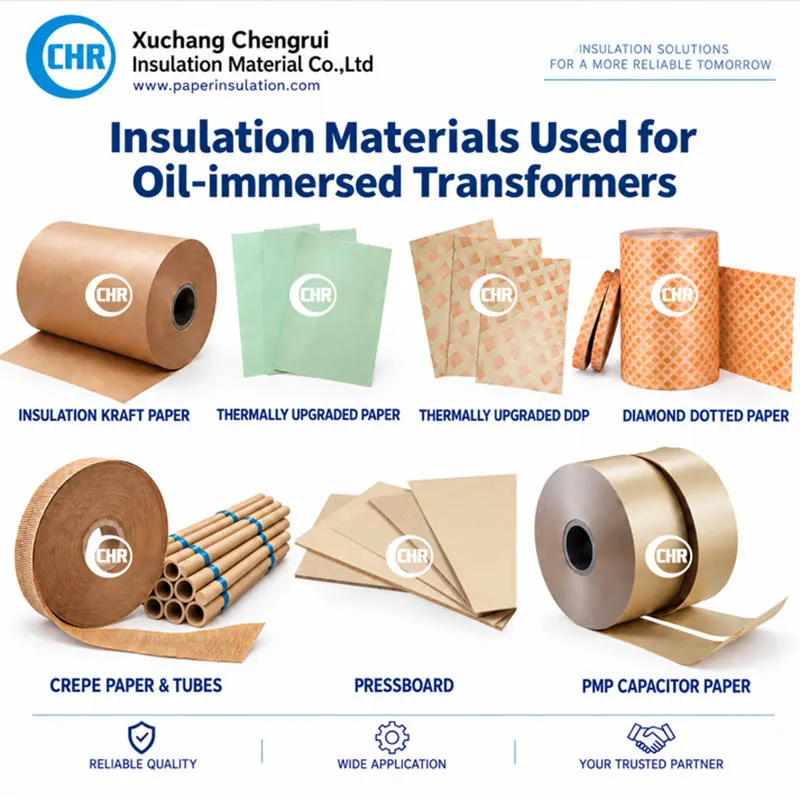
From the solid insulation side, oil-immersed transformers mainly use paper-based and cellulose-based insulation materials.
The main demand includes:
| Transformer Position | Common Materials |
| Conductor wrapping | Kraft insulation paper, thermally upgraded paper |
| Interlayer insulation | Diamond dotted paper, thermally upgraded DDP |
| Lead insulation | Crepe paper, crepe paper tubes |
| Rigid insulation barriers | Transformer pressboard |
| Oil cooling channels | Oil duct strips, pressboard spacer strips |
| Structural support | Laminated densified wood |
| Custom components | Pressboard cylinders, angle rings, spacer blocks, laminated wood parts |
For these transformers, insulation material quality directly affects drying, oil impregnation, winding stability, mechanical support and long-term aging performance.
This is why the demand is not limited to roll paper. Transformer manufacturers also need pressboard parts, oil duct strips, laminated wood support blocks and drawing-based components.
For oil-immersed transformer customers, the main buying question is usually not “Which material is the best?”
The better question is:
Where will this material be used inside the transformer?
A conductor wrapping paper, a winding bonding paper, a lead insulation paper and a pressboard spacer are not interchangeable. They belong to the same insulation system, but they solve different problems.
4. Dry-Type Transformers Are Increasing Demand for Composite Insulation Materials
Dry-type transformers are often used in buildings, indoor substations, industrial facilities, renewable energy systems and places where oil-free operation is preferred.
Their insulation system is different from oil-immersed transformers.
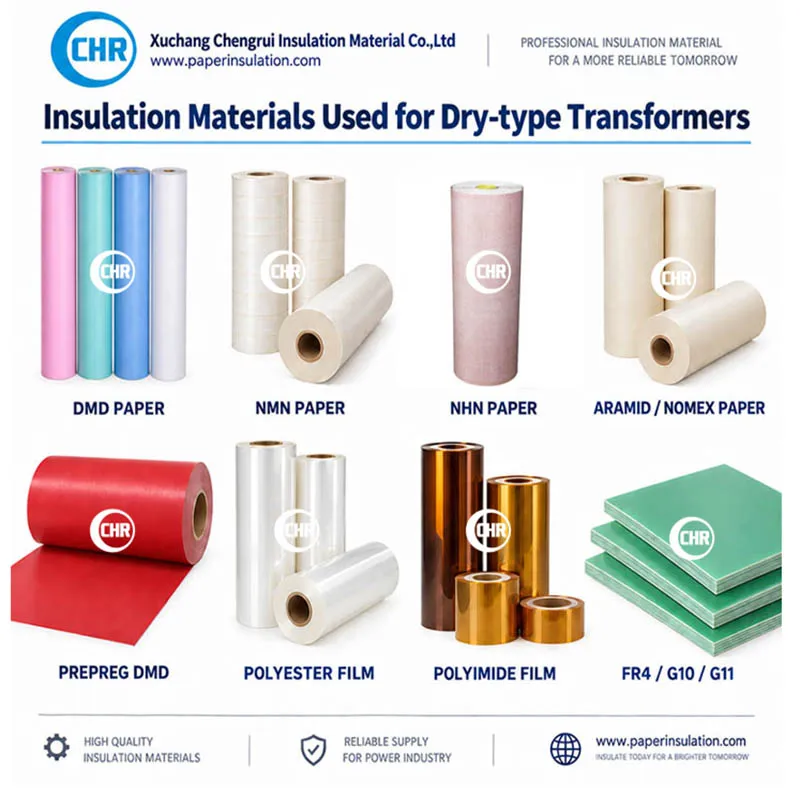
| Application Position | Common Materials |
| Foil winding interlayer insulation | Prepreg DMD |
| Slot, phase and layer insulation | DMD, NMN, NHN |
| High-temperature insulation | Aramid / Nomex® paper |
| Flexible film insulation | Polyester film, polyimide film |
| Rigid support parts | FR4, G10, G11 sheets |
| Custom components | CNC machined epoxy glass parts |
Chengrui products for dry-type transformers
Chengrui can supply:
Prepreg DMD;
DMD Insulation Paper;
NMN Insulation Paper;
NHN Insulation Paper;
Aramid / Nomex® Paper;
Polyester Film;
Polyimide Film;
FR4 Epoxy Glass Sheet;
G10 / G11 Epoxy Glass Sheet;
Custom Machined Insulation Parts.
For dry-type transformer manufacturers, prepreg DMD is a typical material used in foil winding insulation because it provides both electrical insulation and bonding after heat and pressure. FR4, G10 and G11 sheets are also widely used for support plates, terminal boards, spacers and other machined insulation parts.
As dry-type transformers become more common in commercial and industrial applications, demand for Class F, Class H and flame-retardant insulation materials will continue to grow.
5. Renewable Energy and Data Centers Are Raising Reliability Expectations
Renewable energy and data centers are not only increasing power demand. They are also changing what customers expect from power equipment.
Solar farms, wind power projects, energy storage systems and EV charging stations all need transformers, reactors and supporting electrical equipment. Data centers also require stable and redundant power systems.
The IEA estimates that data centers accounted for about 415 TWh of electricity consumption in 2024, around 1.5% of global electricity consumption.
This matters because transformers used in these projects often face long operating hours, strict reliability requirements and tight delivery schedules.
This trend supports demand for materials such as thermally upgraded paper, thermally upgraded DDP, high-density pressboard, laminated densified wood, aramid paper, prepreg DMD and FR4/G10/G11 machined parts.
The more critical the equipment, the less room there is for unstable insulation materials.
6. What Transformer Buyers Really Care About
In transformer insulation material purchasing, price matters. But price is not the only thing.
Most professional buyers also ask:
Is this material suitable for oil-immersed or dry-type transformers?
Can the supplier provide the required thickness and width?
Can the roll be slit to our winding width?
Can the sheet be cut or machined?
Can the supplier produce according to drawings?
Can the material pass our sample test?
Is the packing suitable for export shipment?
Can the supplier support repeat orders?
Can multiple materials be supplied together?
For custom parts, the drawing is often more important than the material name.
For example, “pressboard part” is not enough for production. The supplier also needs to know the thickness, diameter, angle, hole position, tolerance and final application.
The same applies to FR4/G10/G11 machined parts, laminated wood support blocks and oil duct strips.
This is why Chengrui usually recommends confirming the application position before quotation.
7. Chengrui's Material Solution for Transformer Manufacturers
Chengrui supplies electrical insulation materials for oil-immersed transformers, dry-type transformers, motor insulation systems and electrical equipment manufacturers.
Our transformer material supply is built around real application positions, not only product names.
| Oil-immersed transformer materials | |||
| Kraft Insulation Paper | Thermally Upgraded Paper | Thermally Upgraded Diamond Dotted Paper | |
| Transformer Pressboard | Pressboard Cylinders/Angle Rings | Pressboard Strips for Oil Duct | |
| Pressboard Spacer Blocks | Laminated Densified Wood | Machined Laminated Wood Parts | |
| Dry-type transformer materials | |||
| Prepreg DMD | NMN Insulation Paper | NHN Insulation Paper | |
| Aramid / Nomex® Paper | Polyester Film | Polyimide Film | FR4 Epoxy Glass Sheet |
| Custom Machined Insulation Parts | Processing and supply support | ||
For transformer manufacturers, repair workshops and insulation material distributors, this type of supply support can reduce sourcing time and make project communication easier.
8. What This Means for Insulation Material Suppliers
The transformer market is not moving in only one direction.
Oil-immersed transformers continue to need cellulose insulation materials, pressboard parts and laminated wood. Dry-type transformers need composite flexible papers, aramid insulation, prepreg materials and epoxy glass sheets. Renewable energy and data centers require higher reliability. Repair workshops need smaller quantities and more flexible supply.
This creates opportunities for insulation material suppliers who can offer:
stable material quality;
application knowledge;
custom processing;
mixed product supply;
sample support;
export packing;
communication with engineers and purchasing teams.
In this market, selling insulation materials is not only about listing product names.
A good supplier helps customers match the material to the transformer type, insulation position and production process.
That is where Chengrui wants to provide value.
Conclusion
The transformer market is growing because electricity demand, grid upgrades, renewable energy, data centers, industrial electrification and replacement projects are all moving forward.
For insulation material suppliers, this growth is not only about higher volume. It is also about more detailed material requirements.
Oil-immersed transformers need kraft insulation paper, thermally upgraded paper, diamond dotted paper, crepe paper, transformer pressboard, laminated densified wood and oil duct strips. Dry-type transformers need prepreg DMD, DMD, NMN, NHN, aramid paper, polyester film, polyimide film and FR4/G10/G11 insulation sheets.
The right insulation material depends on where it is used, how it is processed and what the transformer design requires.
Chengrui supplies transformer insulation materials and custom insulation components for manufacturers, repair workshops, OEMs and distributors worldwide. Our goal is to help customers select practical materials for real transformer applications, not just provide a product list.


Quick Quote