Motor Winding Insulation Materials: A Practical Guide
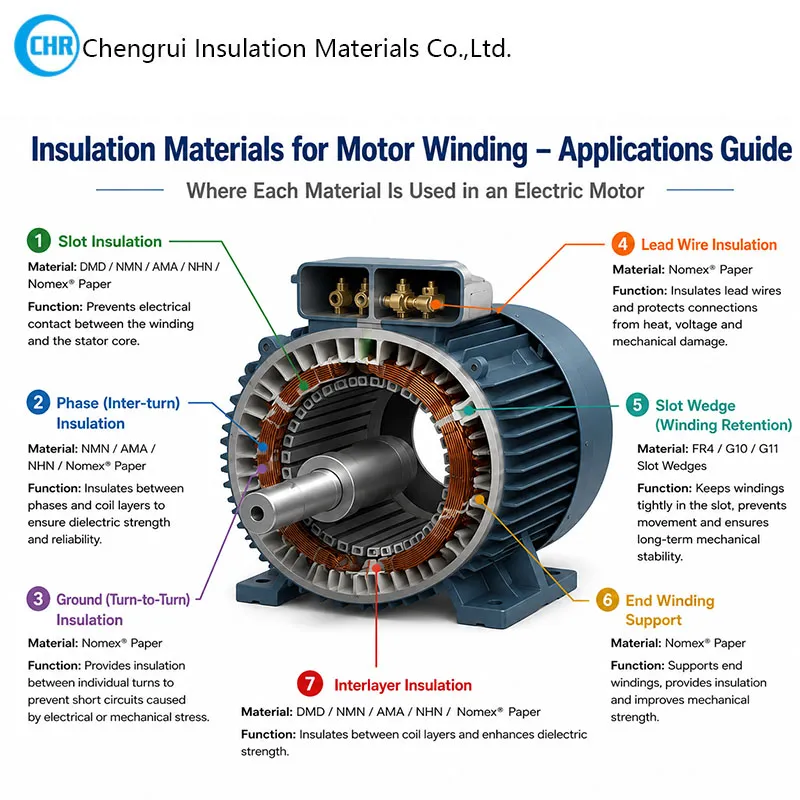
If you are looking for insulation materials used in motor windings, the most common materials include: DMD/NMN/AMA/NHN/Nomex® Paper/FR4 / G10 / G11 Slot Wedges etc. These materials are used in different parts of a motor, including slot insulation, phase insulation, lead wire protection, end winding support and slot retention.
The exact material depends on the motor's insulation class, operating temperature and application requirements.
Why Motors Need Different Insulation Materials
A motor winding is exposed to:
Heat
Vibration
Electrical stress
Humidity
Mechanical movement
No single material can handle all these requirements.
That is why motor manufacturers use a combination of insulation materials rather than relying on one product.
A complete motor insulation system usually contains insulation paper, film, sleeving, tape and slot wedges.
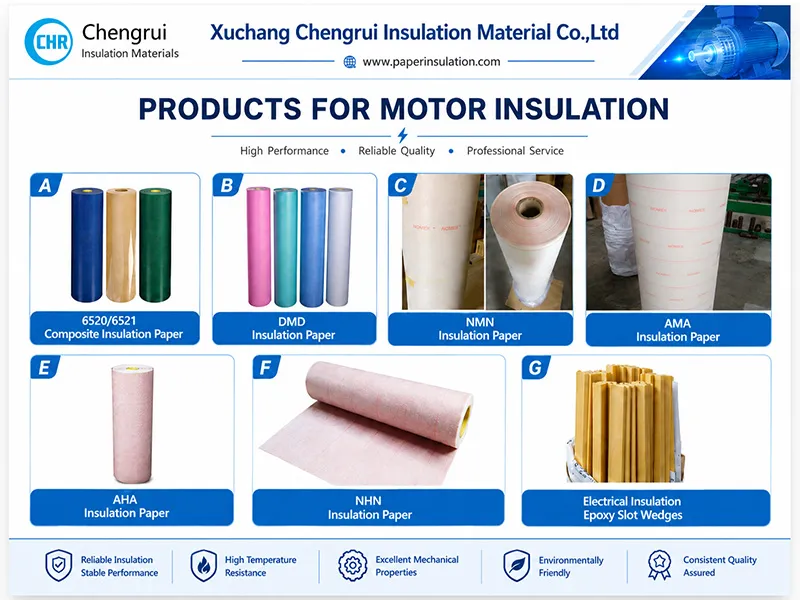
DMD Insulation Paper
The Most Widely Used Motor Insulation Material
DMD insulation paper consists of: Polyester Nonwoven Fabric + Polyester Film + Polyester Nonwoven Fabric
DMD has been used in motor manufacturing for decades because it provides a good balance between performance and cost.
Typical applications include:
Slot insulation
Phase insulation
Interlayer insulation
General industrial motors
DMD is commonly used in Class B and some Class F motor insulation systems.
For standard industrial motors, it remains one of the most economical insulation materials available.
NMN Insulation Paper
One of the Most Popular Class F Insulation Materials
NMN consists of: Nomex® Paper + PET Film + Nomex® Paper
Compared with DMD, NMN offers significantly better thermal performance.
Common applications:
Industrial motors
Compressor motors
Generator windings
Heavy-duty motors
Many motor manufacturers choose NMN when they need a reliable Class F (155°C) insulation system without moving to more expensive Class H materials.
AMA Insulation Paper
Better Moisture Resistance for Demanding Environments
AMA consists of:Aramid Paper + PET Film + Aramid Paper
Structurally it looks similar to NMN, but the material system is different.
Advantages include:
Good mechanical strength
Excellent thermal performance
Better moisture resistance
Improved dimensional stability
AMA is often selected for motors operating in humid environments or applications requiring improved durability.
NHN Insulation Paper
A Common Choice for Class H Motors
NHN consists of: Nomex® Paper + Polyimide Film + Nomex® Paper
The polyimide core dramatically increases thermal performance.
Typical applications include:
EV drive motors
Railway traction motors
Wind turbine generators
High-temperature industrial motors
When motor operating temperatures become more demanding, NHN is often the next step beyond NMN.
Nomex® Paper
The Benchmark Material for High-Performance Motors
Nomex® paper is one of the most recognized electrical insulation materials in the motor industry.
Unlike composite materials such as NMN and NHN, Nomex can be used directly as insulation paper.
Typical applications:
Slot insulation
Phase insulation
Ground insulation
Generator insulation systems
Advantages include:
Class H thermal performance
Long service life
Excellent dielectric strength
High mechanical durability
Many premium motors and generators rely heavily on Nomex-based insulation systems.
FR4, G10 and G11 Slot Wedges
The Mechanical Component That Holds Everything Together
When discussing motor insulation, most attention goes to insulation paper.
However, slot wedges are equally important.
Their primary function is to keep the winding securely inside the stator slot.
Without a reliable slot wedge, winding movement can occur during operation.
Which Material Should You Choose?
There is no single "best" insulation material for motor winding.
The correct choice depends on:
Insulation class
Operating temperature
Motor type
Service life requirements
Budget
| Motor Type | Common Insulation Materials |
| Class B Motors | DMD + G10 or FR4 |
| Class F Motors | NMN or AMA |
| Class H Motors | NHN or Nomex + G11 |
Final Thoughts
Although hundreds of insulation materials exist, most motor winding insulation systems are built around a relatively small group of proven products.
DMD remains the economical choice.
NMN and AMA dominate many Class F applications.
NHN and Nomex are widely used in Class H systems.
FR4, G10 and G11 slot wedges provide the mechanical support needed to keep windings secure throughout the life of the motor.
Understanding the role of each material is the first step toward selecting a reliable motor insulation system.


Quick Quote