Why Oil-Immersed Transformers Need Both Pressboard and Crepe Paper
When people look inside a transformer for the first time, they are often surprised by how many different insulation materials are used.There is electrical kraft paper wrapped around conductors.
There are insulation pressboard cylinders between windings.
Crepe paper appears on leads and connection points.
Pressboard strips form oil ducts.
Angle rings sit at the winding ends.
At first glance, many of these materials seem similar. Most are cellulose-based and all are part of the transformer insulation system.
So why does a transformer need both pressboard and crepe paper?
The answer becomes obvious once you look at where each material is actually used.
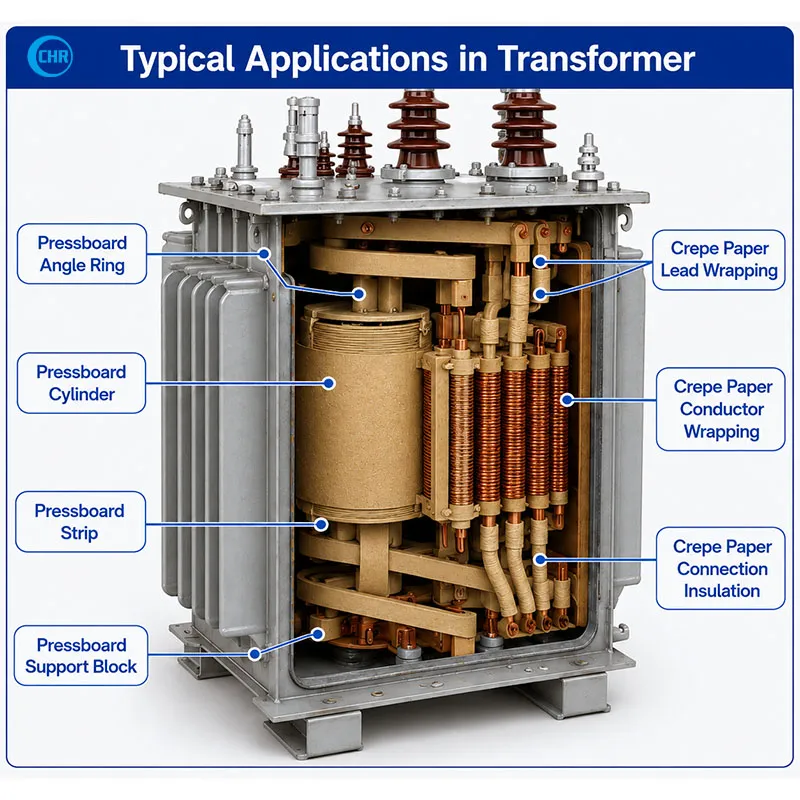
Two Different Problems Inside a Transformer
Inside an oil-immersed transformer, insulation materials usually perform one of two jobs.
The first job is to support the winding structure.
The second job is to insulate conductors and leads.
Those two requirements sound similar, but they demand completely different material properties.
A material strong enough to support several hundred kilograms of winding weight is usually not flexible enough to wrap around a conductor.
A material flexible enough to wrap around a lead is usually not strong enough to support a winding assembly.
This is exactly why transformer manufacturers use both pressboard and crepe paper.
Where Pressboard Is Actually Used
If you remove the windings from a transformer, many of the remaining insulation components will be made from pressboard.
For example:
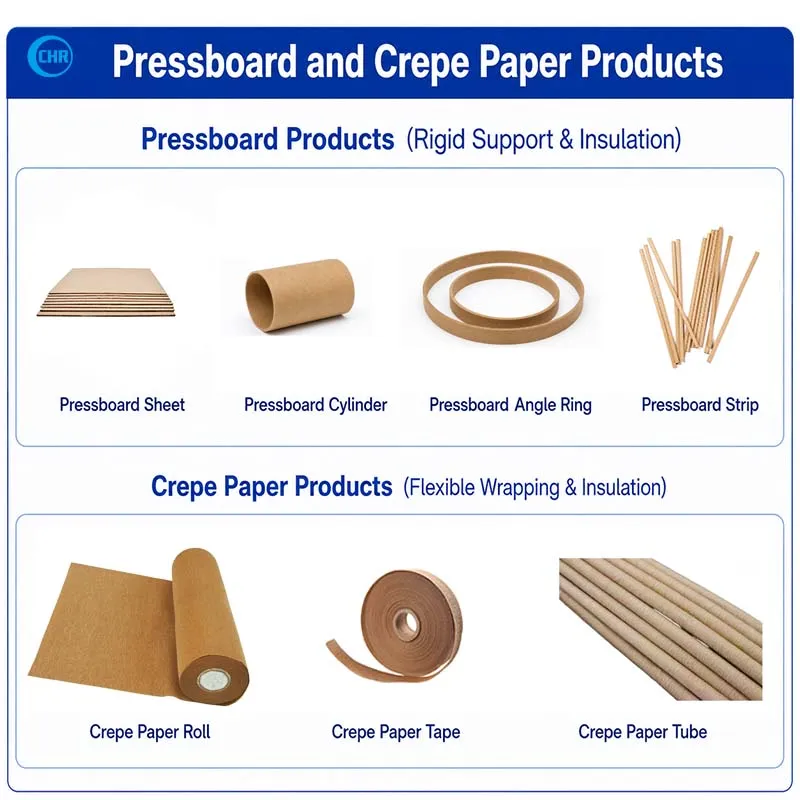
Pressboard cylinders Pressboard angle rings Pressboard strips Spacer blocks Support blocks End rings
These components are not installed because they are easy to process.
They are installed because they must withstand mechanical stress for decades.
Take a pressboard cylinder as an example.
Its job is not simply insulation.
It must keep the HV winding and LV winding separated while maintaining the geometry of the winding assembly.
In large power transformers, a cylinder may remain under mechanical pressure for twenty or thirty years.
This is where high-density transformer pressboard becomes important.
The material offers:
High compressive strength
Excellent oil compatibility
Dimensional stability
Reliable dielectric performance
Without pressboard, the transformer would lose much of its structural integrity.
The Places Where Pressboard Cannot Work
Now imagine a transformer lead coming out of a winding.
The conductor bends several times before reaching the terminal.
The surface is uneven.
The shape changes direction.
Trying to wrap this lead with a rigid pressboard sheet would be nearly impossible.
This is where crepe paper becomes useful.
Why Transformer Workshops Always Keep Crepe Paper in Stock
Visit almost any transformer workshop and you will usually find rolls of crepe paper somewhere near the winding area.
There is a simple reason.
Crepe paper solves many small insulation problems that rigid materials cannot.
The creping process gives the paper flexibility and elongation.
When wrapped around a conductor or lead, the paper can follow curves and irregular shapes without cracking.
This makes crepe paper particularly useful for:
Lead insulation
Conductor wrapping
Coil connections
Repair work
Transformer rewinding
In many factories, technicians use crepe paper every day because it is practical, easy to handle and adaptable.
A Good Example: Transformer Leads
Transformer leads are one of the easiest ways to understand the difference between these materials.
The lead itself needs insulation.
But it also needs to bend.
It passes through different parts of the transformer and often changes direction several times.
Pressboard is too rigid for this job.
Crepe paper can be wrapped tightly around the conductor and still maintain flexibility.
This is why lead insulation is one of the most common applications for transformer crepe paper.
A Good Example: Transformer Windings
Now look at the winding assembly itself.
The winding must be supported.
Oil circulation channels must be maintained.
Electrical clearances must remain stable.
This is where pressboard takes over.
Pressboard cylinders, strips and support blocks create the framework that keeps the winding system in place.
Crepe paper cannot perform this function because it lacks the required mechanical strength.
Why Both Materials Age Well in Transformer Oil
One reason these materials have remained popular for decades is their compatibility with transformer oil.
After drying and oil impregnation, both become part of the oil-paper insulation system.
This system has been used successfully in transformers around the world for generations.
Although modern insulation materials continue to evolve, cellulose-based insulation still remains the foundation of most oil-immersed transformer designs.
What Transformer Manufacturers Usually Purchase Together
Interestingly, transformer factories rarely buy pressboard or crepe paper separately.
A typical purchasing list often includes:
Transformer pressboard sheets
Pressboard components( cylinders, angle rings, strips etc)
Electrical crepe paper
Crepe paper tape
Diamond dotted paper
Laminated wood components
Each material serves a specific purpose, but together they create a complete insulation system.
Conclusion
Pressboard and crepe paper are often grouped together because both are cellulose insulation materials used in oil-immersed transformers.
In practice, however, they solve completely different problems.
Pressboard provides the structure.
Crepe paper provides the flexibility.
One supports the transformer.
The other adapts to it.
That is why even in modern transformer designs, both materials continue to play essential roles in building reliable insulation systems.
At Chengrui Insulation, we supply a complete range of transformer insulation materials including transformer pressboard, pressboard cylinders, angle rings, pressboard strips, electrical grade crepe paper, crepe paper tubes and custom-machined transformer insulation components.
Our engineering team helps transformer manufacturers select the right insulation materials based on voltage level, winding design and operating conditions.


Quick Quote