G10 vs FR4 Fiberglass Sheet: Differences for Electrical Insulation
G10 and FR4 are both epoxy glass cloth laminated sheets. They look similar, machine in a similar way, and are both used for electrical insulation parts.
The main difference is simple:
FR4 is a flame-retardant epoxy fiberglass sheet. Standard G10 is not designed as a flame-retardant grade.
For many electrical insulation parts, both materials can provide good mechanical strength and dielectric performance. But when the application requires flame resistance, FR4 is usually the safer and more common choice.
For buyers, the question is not only “Which material is better?”
The better question is: Does your part require flame retardancy, or only mechanical strength and electrical insulation?
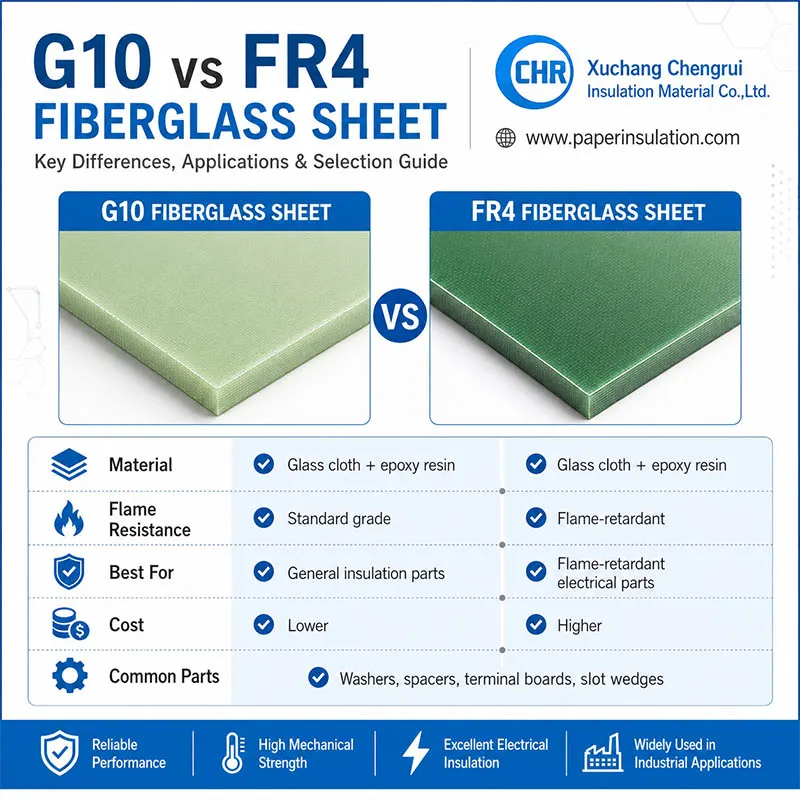
G10 vs FR4 Quick Comparison
| Item | G10 Fiberglass Sheet | FR4 Fiberglass Sheet |
| Base Material | Glass cloth + epoxy resin | Glass cloth + flame-retardant epoxy resin |
| Flame Resistance | Not normally flame-retardant | Flame-retardant grade |
| Common Standard | NEMA G10 type material | NEMA FR4 type material |
| Thermal Class | Class B 130℃ | Class B 130℃ |
| Best For | Structural insulation parts without flame-retardant requirement | Electrical insulation parts requiring flame resistance |
Choose G10 when mechanical strength and insulation are the main requirements. Choose FR4 when flame retardancy is also required.
What Is G10 Fiberglass Sheet?
G10 fiberglass sheet is made from glass cloth impregnated with epoxy resin and laminated under heat and pressure.
It has high mechanical strength, good electrical insulation performance and good dimensional stability. It is widely used for machined insulation parts where strength, rigidity and insulation are required.
Common G10 applications include:
insulating washers;
spacers;
support plates;
terminal boards;
structural insulation parts;
motor slot wedges;
transformer support parts;
CNC machined insulation components.
G10 is often selected when the part needs strong mechanical support, but the specification does not require flame-retardant performance.
What Is FR4 Fiberglass Sheet?
FR4 fiberglass sheet is also made from glass cloth and epoxy resin, but the resin system is designed to provide flame-retardant performance.
This is the main reason FR4 is widely used in electrical and electronic insulation applications. It is often selected when the part works near electrical components or when the customer drawing clearly requires flame retardancy.
Common FR4 applications include:
electrical insulation boards;
switchgear insulation parts;
terminal support plates;
relay and control cabinet parts;
insulating spacers;
PCB-related insulation parts;
CNC machined electrical insulation components;
motor and transformer insulation parts requiring flame resistance.
FR4 is usually more suitable than G10 when safety requirements, flame-retardant specifications or customer drawings require FR4 grade material.
Key Difference 1: Flame Resistance
Flame resistance is the most important difference between G10 and FR4.
Standard G10 is not normally used when flame-retardant performance is required. FR4 is designed for applications where the material should resist burning and self-extinguish under specific test conditions.
This difference matters in electrical equipment because insulation parts may work close to current-carrying parts, terminals, circuit components or heat sources.
Choose FR4 when:
the drawing specifies FR4;
the application requires flame-retardant insulation material;
the part is used inside electrical control equipment;
the buyer needs better safety margin around electrical components;
the customer requests UL94 V-0 or similar flame-retardant performance.
Choose G10 only when flame-retardant performance is not required by the design or standard.
Key Difference 2: Application Direction
G10 is often used as a strong structural insulation material.
FR4 is used more often in electrical and electronic insulation applications where flame resistance is important.
| Application | Better Choice | Reason |
| General insulating spacer | G10 or FR4 | Depends on flame requirement |
| Terminal support plate | FR4 | Flame resistance is often preferred |
| Motor slot wedge | G10, G11 or FR4 | Depends on temperature and design |
| Switchgear insulation part | FR4 | Better for electrical safety requirements |
| CNC machined insulation part | G10 or FR4 | Choose according to drawing |
Key Difference 3: Cost
G10 is usually more economical than FR4.
If the part only needs mechanical strength and basic electrical insulation, G10 may be enough. But if the part requires flame resistance, using G10 only to reduce cost may create risk.
For purchasing, the correct logic should be:
If the drawing says FR4, use FR4.
If flame retardancy is required, use FR4.
If only mechanical insulation is required, G10 can be considered.
If the part works under higher temperature, G11 may also need to be checked.
Material cost should not be the first selection factor. The insulation system and safety requirement should come first.
Key Difference 4: Color Is Not a Reliable Way to Identify Material
Some buyers try to distinguish G10 and FR4 by color.
This is not reliable.
Green is common for both G10 and FR4. Yellow, natural, black and other colors may also be available depending on production and customer requirement.
The correct way to confirm the material is to check:
material grade;
technical datasheet;
flame-retardant requirement;
test report;
customer drawing;
purchase specification.
Color can help with identification inside a workshop, but it should not be used as the only proof of material grade.
What to Confirm Before Ordering G10 or FR4 Sheet
Before quotation, buyers should confirm the following information:
| Selection Point | What to Confirm |
| Material Grade | G10, FR4, G11 or FR5 |
| Flame Requirement | Whether flame retardancy is required |
| Thickness | Sheet thickness or part thickness |
| Machining | Cutting, drilling, CNC or punching |
| Application | Motor, transformer, switchgear, electrical cabinet or mechanical part |
Related Materials
For different electrical insulation applications, Chengrui can also supply:
FR4 Epoxy Fiberglass Laminated Sheet
G10 G11 Epoxy Laminated Insulation Sheet
FR5 Laminated Insulation Sheet
3240 Epoxy Glass Cloth Laminated Sheet
EPGC 308 Epoxy Fiberglass Laminated Board
FAQ
Q1: What is the main difference between G10 and FR4?
A: The main difference is flame resistance. G10 is a standard epoxy fiberglass laminate, while FR4 is a flame-retardant epoxy fiberglass laminate.
Q2: Is FR4 stronger than G10?
A: Not necessarily. Both materials have high mechanical strength. The main reason to choose FR4 is flame resistance, not simply higher strength.
Q3: Can G10 be used instead of FR4?
A: Only if the application does not require flame-retardant performance and the customer approves the substitution. If the drawing specifies FR4, G10 should not be used directly.
Q4: Which material is better for CNC machined insulation parts?
A: Both G10 and FR4 can be CNC machined. The choice depends on flame requirement, application environment, working temperature and customer drawing.
Q5: Which material is better for switchgear insulation parts?
A: FR4 is often preferred for switchgear and electrical cabinet parts because flame-retardant performance is usually important in these applications.
Conclusion
G10 and FR4 fiberglass sheets are both epoxy glass cloth laminated materials used for electrical insulation and machined parts.
The key difference is flame resistance. G10 is suitable for general mechanical and electrical insulation parts when flame retardancy is not required. FR4 is more suitable for electrical equipment, switchgear, electrical cabinets and parts requiring flame-retardant performance.
For buyers, the safest way to choose is to start from the drawing and application requirement. Confirm whether flame retardancy, temperature class, thickness, machining and tolerance are required before placing an order.
Chengrui supplies G10, FR4, G11, FR5 and other epoxy fiberglass laminated sheets in full sheets, cut pieces and customized machined insulation parts.


Quick Quote