DMD vs NMN Insulation Paper for F-Class Motors
DMD vs NMN Insulation Paper for F-Class Motors
How to choose the right flexible composite insulation paper for slot, phase and winding insulation
DMD and NMN are two common flexible composite insulation papers used in electric motor insulation systems.
Both materials are used for motor slot insulation, phase insulation, turn insulation and winding insulation. They are supplied in rolls or sheets and can be cut, formed or inserted into motor slots according to the motor design.
Although both materials are used in F-Class motor insulation systems, they are not the same.
DMD insulation paper is a polyester-based composite insulation material. It is usually selected for standard motor insulation applications where cost, flexibility and processing performance are important.
NMN insulation paper is an aramid paper and polyester film composite material. It offers better heat resistance, mechanical strength and overall insulation reliability than standard DMD, especially in higher-demand motor applications.
For motor manufacturers and repair workshops, the key question is not simply “Which material is better?”
The real question is:
Which material is more suitable for your motor temperature class, voltage level, working environment and cost target?
Chapter 1: Deciphering the Structures of DMD and MNM
DMD: A Cost-Effective Choice Based on Polyester
The structure of DMD is as its name suggests—a three-layer symmetrical design:
Outer Layer D: Polyester nonwoven fabric (thickness 0.05-0.10mm)
Middle Layer M: Polyester film(Mylar film)
Inner Layer D: Polyester nonwoven fabric
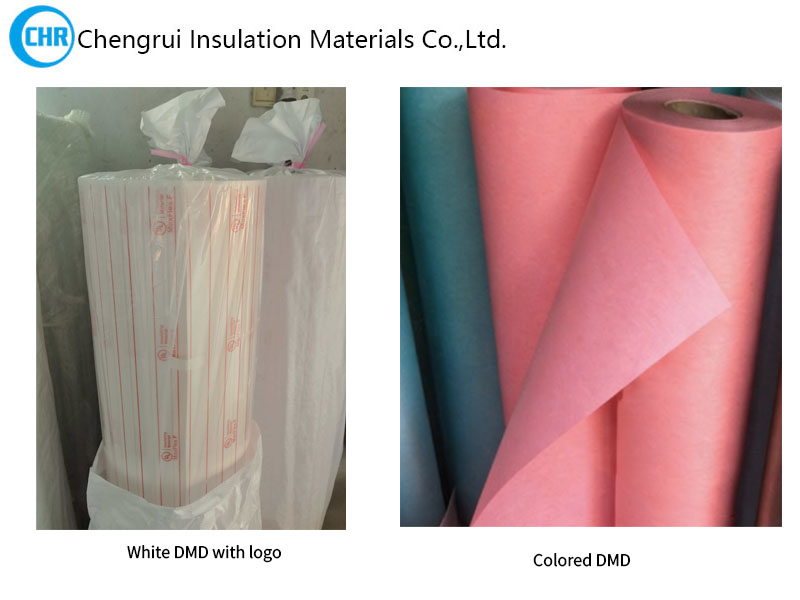
This structure cleverly combines the mechanical strength of nonwoven fabric with the electrical properties of film. The polyester fiber layer provides excellent tear resistance and flexibility, making the material less prone to damage during automatic winding; the middle PET film contributes excellent dielectric strength and moisture resistance.
Manufacturing Process: Utilizing hot-pressing lamination technology, the three layers are firmly bonded together using a thermoplastic adhesive at a temperature of 120-150°C and a pressure of 1-3MPa.
NMN: High-Performance Insulation Solution
NMN represents a higher performance insulation standard:
Outer Layer N: Nomex® Paper
Middle Layer M: Polyester film (Mylar film)
Inner Layer N: Nomex®Paper

Nomex® is a DuPont patented material made of aramid fibers, possessing inherent flame retardancy and high-temperature stability. The addition of the mica layer significantly improves its corona resistance, making it particularly suitable for inverter power supply applications.
Manufacturing Process: Impregnated with epoxy or silicone resin and cured at 180-200°C.
Chapter Two: Performance Comparison
Thermomechanical Performance Comparison
Thermal Stability Test (155°C, 1000 hours of aging):
DMD: Mechanical strength retention rate approximately 70%. NMN: Mechanical strength retention rate >85%
Case Study: A water pump manufacturer reported that in motors using DMD insulation, insulation embrittlement began to occur after 3 years when operating temperatures exceeded 140°C. After switching to NMN, no significant aging was observed after 5 years of operation under the same conditions.
Chemical compatibility:
Both are resistant to transformer oil and lubricating oil.
NMN has better resistance to refrigerants and weak acids and alkalis.
Chapter Three:Application of DMD and NMN electrical insulation paper
When to Choose DMD?
1: Cost-Sensitive Mass Production
"In a project producing 100,000 household air conditioner compressor motors annually, we chose 0.15mm DMD as the slot insulation material. Compared to NMN, the cost per unit is reduced by approximately 2.5 yuan, resulting in annual cost savings of 2.5 million yuan, while fully meeting product lifespan requirements." — Technical Director of a home appliance company
2: Standard Industrial Environment
Voltage Rating: ≤690V
Ambient Temperature: -20°C to 155°C
Humidity Requirement: Relative Humidity ≤85%
Typical Applications: General equipment such as fans, pumps, and conveyor belts
Recommended Configuration:
Slot Insulation: 0.15-0.20mm DMD
Phase-to-Phase Insulation: 0.25mm DMD
Manufacturing Process: VPI impregnation or drip coating process
When to Choose NMN?
1: Motor Powered by a Frequency Converter
"Our mine hoist uses frequency converter control. Initially, it used DMD insulation, which developed inter-turn short circuits after two years of operation. After switching to NMN, it has maintained good performance for five years. Corona resistance is key!" — A mine equipment maintenance engineer
2: High Voltage and Harsh Environment
Voltage Rating: 690V-10kV
Ambient Temperature: May exceed 155°C
Presence of corrosive gases or liquids
Certification Requirements: ATEX, UL, etc.
Recommended Configuration:
Inter-turn Insulation: 0.08mm NMN
Main Insulation: 0.18-0.25mm NMN
Special Treatment: Edge reinforcement, anti-corona coating
Chapter Four: Cutting-Edge Technology – Future Development Trends
The Evolution of Next-Generation DMD:
Nano-Reinforced: Adding nano-alumina improves corona resistance by 3 times.
High Thermal Conductivity: Thermal conductivity increased to 0.25 W/(m·K), aiding in motor heat dissipation.
Bio-Based and Environmentally Friendly: Using renewable raw materials, reducing carbon footprint by 40%.
NMN Technological Breakthroughs:
Low-Temperature Curing: Curing temperature reduced from 200°C to 130°C, resulting in significant energy savings.
Self-Diagnostic and Intelligent: Integrated sensors monitor insulation status in real time.
Ultra-Thin and High-Strength: Maintaining integrity performance with a thickness of 0.05 mm.
Choosing between DMD and NMN is never a simple binary decision. It requires comprehensive consideration of:
Technical factors: voltage, frequency, temperature, environment
Economic factors: initial cost, operating cost, maintenance cost
Strategic factors: product positioning, market requirements, supply chain security
A senior motor designer once said, "The best insulation material is not the one with the strongest performance, but the one that is most suitable."
In today's rapidly evolving motor technology, insulation materials are also constantly improving. Regardless of the material chosen, the key is to establish a systematic selection method, a rigorous verification process, and a comprehensive quality control system.


Quick Quote