Thermally Upgraded Kraft Paper: 9 Checks Before Buying
When a transformer manufacturer sends an RFQ for thermally upgraded kraft paper, the request often looks simple:
0.075 mm × 1000 mm, TUP paper, 120°C, 500 kg.
But this is usually not enough information to approve a material for production.
Two suppliers may quote material with the same thickness, width and description, yet the actual paper can differ in thermal upgrading method, density, tensile strength, moisture condition, roll quality and supporting test documentation.
For a purchasing team, the real question is therefore not:
“Who offers the lowest price per kilogram?”
It is:
“How do I know this TUP paper matches our transformer design and will run consistently in production?”
This guide focuses on the points transformer manufacturers, conductor producers and insulation material distributors should check before purchasing thermally upgraded kraft paper.
1. First Confirm What “TUP” Actually Means in the RFQ
The first purchasing risk is surprisingly basic: different suppliers may use different names for similar materials.
You may see:
TUP paper
TUK paper
Thermally upgraded kraft paper
Thermally upgraded insulation paper
Heat-resistant kraft paper
In many transformer applications, these descriptions refer to chemically modified cellulose insulation paper designed to reduce the rate of thermal degradation.
However, TUP should not be confused with:
standard electrical kraft paper, which is not thermally upgraded;
or
TU DDP, which uses thermally upgraded paper as the base material but also has B-stage epoxy resin dots for winding bonding.
Weidmann describes thermally upgraded kraft papers as chemically modified cellulose papers designed to reduce decomposition during thermal aging. It also offers low-, medium- and high-density TU grades for different transformer applications.
What the buyer should ask
Do not send only:
Please quote 0.075 mm TUP.
Instead confirm:
Thermally upgraded kraft insulation paper, smooth surface, no epoxy coating, for conductor wrapping / winding insulation in an oil-immersed transformer.
That one sentence removes a lot of ambiguity.
2. What Standard or Specification Is the Paper Being Supplied Against?
This is one of the most important questions in a serious procurement process.
A supplier may say:
120°C thermally upgraded paper
but that alone does not define the complete technical requirement.
Thermal class in liquid-immersed transformer applications relates to the insulation system, not simply one isolated sheet of paper. Industry thermal-aging evaluations consider the paper together with other solid insulation materials and the insulating liquid. Weidmann's published thermal-aging work also stresses that thermal-class definitions cannot simply be assigned independently to one material without considering the system.
For example, IEC 60076-14 recognizes a semi-hybrid insulation system using thermally upgraded kraft paper with mineral oil at a higher thermal class than a conventional kraft-paper system.
What the buyer should ask
Ask the supplier:
Which standard, customer specification or test basis is used for this grade?
If you already have an approved drawing or existing material datasheet, send it before quotation.
For replacement projects, specification matching is usually more useful than simply asking:
“Is your paper Class E?”
3. Do Not Check Thickness Alone — Check Grammage and Density Too
Most RFQs start with paper thickness:
0.05 mm
0.075 mm
0.085 mm
0.10 mm
0.13 mm
Thickness is important because it affects electrical clearance, winding build and final coil dimensions.
But two papers with the same nominal thickness do not necessarily have the same structure.
Grammage and apparent density affect:
mechanical strength, compressibility, porosity, oil impregnation and winding behavior.
This is why established insulation-paper producers distinguish between low-, medium- and high-density thermally upgraded papers rather than treating all TU papers as one grade.
A better RFQ should include
| Parameter | Example |
| Paper type | Thermally upgraded paper |
| Thickness | 0.075mm |
| Grammage | Supplier/customer specification |
| Density | Supplier/customer specification |
| Width | 1000mm or customized |
| Application | Conductor wrapping |
| Transformer type | Oil-immersed distribution transformer |
If you are replacing an existing brand, providing the current TDS is often the fastest way to identify whether the proposed Chinese material is genuinely comparable.
4. Mechanical Properties Matter During Wrapping and Winding
A laboratory paper can meet thickness requirements and still create problems on the production line.
For conductor wrapping and winding applications, buyers should pay particular attention to:
machine-direction tensile strength, cross-direction tensile strength, elongation and tear behavior.
Kraft flat papers are widely used for conductor insulation partly because they combine purity with strength and elongation suitable for wrapping processes.
This matters even more when the paper runs continuously on automatic wrapping equipment.
Typical production complaints caused by unsuitable paper include:
paper breaking during wrapping;
unstable tension;
poor edge folding;
excessive dust;
uneven winding;
or rolls that behave differently from one batch to another.
Procurement advice
For a new supplier, do not approve the material from a TDS alone.
Ask for a trial roll or production sample and test it on your actual wrapping or winding equipment.
The most useful question is not: “Does your tensile strength meet the datasheet?”
It is: “Can the paper run consistently on our production line at our normal machine tension and speed?”
5. How Is the Thermal Upgrading Verified?
This is where purchasing thermally upgraded paper becomes different from purchasing ordinary kraft paper.
Because standard kraft and TUP can look very similar, visual inspection cannot prove that a paper has been thermally upgraded.
Color is also not enough.
Thermally upgraded paper may be natural brown or dyed, depending on grade and supplier. Appearance should therefore never be the only acceptance criterion.
Thermal upgrading involves chemical modification of cellulose to slow thermal degradation. Nitrogen-containing stabilizing systems are commonly associated with TU papers, so nitrogen content is often used as one of the indicators during material qualification.
What the buyer should request
Depending on your project, ask for:
TDS
batch test report
thermal-aging qualification information
nitrogen-content data where applicable
CoA or CoC when required
If a supplier can only say:
“This is 120°C paper because it is green,”
that is not a sufficient technical basis for supplier approval.
6. Moisture Is a Procurement Issue, Not Only a Production Issue
Cellulose insulation is hygroscopic.
That means the condition in which the material is produced, packed, stored and transported matters.
A paper may leave the factory in acceptable condition but absorb moisture during:
warehouse storage; container transportation; humid port handling or long-term storage after arrival.
Transformer manufacturers already spend significant effort drying cellulose insulation before oil impregnation. Moisture control during supply therefore directly affects downstream processing.
Transformer insulation specialists use moisture content and degree of polymerization measurements when evaluating dry-out and aging behavior of cellulose insulation.
Buyers should therefore confirm
The agreed moisture requirement;
whether rolls are sealed in moisture-resistant packaging;
whether desiccant or additional barrier packing is needed;
how long the material may remain stored before use;
and whether export packaging changes for sea freight.
For TUP shipped internationally, packaging quality is part of the material specification.
7. Which Insulating Liquid Will Be Used?
Thermally upgraded kraft paper is widely used in liquid-immersed transformer insulation systems, but procurement should still identify the actual liquid system.
Is the transformer using:
mineral oil?
natural ester?
synthetic ester?
The thermal behavior of solid insulation should be evaluated together with the liquid insulation system.
Industry thermal-aging testing therefore evaluates combinations of paper, transformerboard and insulating liquid rather than paper in isolation.
What purchasing should tell the supplier
Instead of saying only:
Application: transformer.
State:
Oil-immersed transformer using mineral oil.
or:
Distribution transformer using natural ester fluid.
This gives the technical team much better information for material review.
8. Roll Quality Can Matter as Much as the Paper Datasheet
This is one area buyers often overlook until material reaches production.
For roll material, purchasing should confirm:
roll width;
width tolerance;
core inner diameter;
maximum outer diameter;
roll weight;
winding direction;
number of joints allowed;
edge condition;
slitting accuracy.
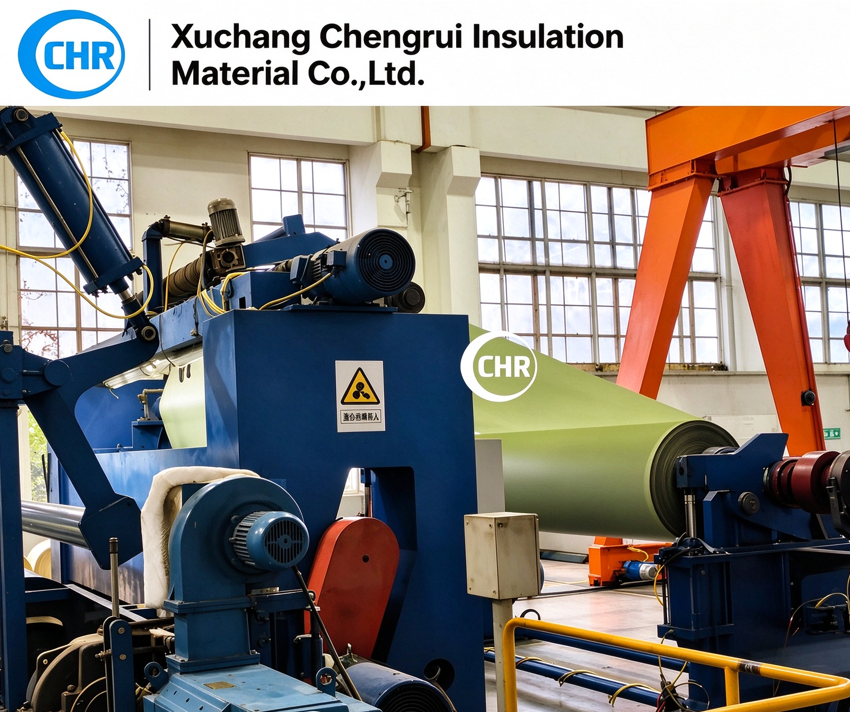
For example, a 1000 mm master roll may be acceptable for one transformer manufacturer but useless for another customer whose wrapping machine requires multiple narrow slit rolls.
Poor slitting can also create:
frayed edges;
paper dust;
uneven tension;
edge tearing;
and tracking problems during high-speed wrapping.
This should be discussed before quotation
If the end use is conductor wrapping, tell the supplier the actual slit width.
If your machine has limitations on roll OD or core size, provide those dimensions.
A professional TUP quotation should describe the finished usable roll, not only the raw paper.
9. Ask How Batch Consistency Is Controlled
One approved sample does not guarantee every future shipment will behave the same.
For repeat transformer production, buyers are often more concerned about consistency than about achieving the highest possible number on one test.
Important repeat-order controls include:
thickness consistency;
grammage consistency;
mechanical properties;
moisture;
thermal-upgrading indicators;
surface condition;
slitting quality;
and roll dimensions.
For regular purchasing, ask:
Will the same grade and production specification be maintained?
Can batch test records be supplied?
How are changes in raw material or production process controlled?
Can approved samples or specifications be retained as reference standards?
This becomes particularly important when TUP is used continuously in paper-covered conductor production or high-volume distribution transformer manufacturing.
How Chengrui Supports TUP Purchasing Projects
Chengrui supplies thermally upgraded kraft paper for oil-immersed transformer manufacturers, conductor manufacturers, insulation converters and electrical material distributors.
Common requirements include thin-gauge thermally upgraded paper for conductor wrapping, winding insulation and layer insulation, supplied as master rolls or customized slit rolls.
For new projects, Chengrui can support:
specification comparison; custom width slitting; sample evaluation; technical documentation; packing confirmation; and bulk export supply.
FAQ for Thermally Upgraded Kraft Paper Buyers
Is TUP the same as ordinary electrical kraft paper?
No. Both are cellulose-based electrical insulation papers, but TUP is chemically modified to reduce the rate of degradation during thermal aging.
Is all 120°C transformer paper the same?
No. A temperature description alone is not enough to establish material equivalence. Buyers should check the actual paper specification, thermal-upgrading qualification and the insulation system in which it will be used.
Can color prove that a paper is thermally upgraded?
No. Natural and colored grades are available. Supplier documentation and agreed test criteria are more reliable than visual identification.
Final Thoughts
Buying thermally upgraded kraft paper is not difficult, but buying the right TUP requires more than comparing thickness and price.
A serious purchasing review should answer four questions:
Is it really the thermally upgraded grade our design requires?
Does it match our approved physical and mechanical specification?
Will the finished roll run reliably in our production process?
Can the supplier maintain the same quality from sample approval through repeat bulk orders?
When those four questions are answered clearly, supplier comparison becomes much easier.
For transformer manufacturers sourcing thermally upgraded kraft paper, Chengrui can review existing specifications or reference datasheets and support customized roll sizes, samples, technical documentation and bulk supply.


Quick Quote