Crepe Paper for Transformer Lead Insulation: Tape or Tubes?
Electrical-grade crepe paper is used for conformable insulation around transformer leads, bends and connection areas. Slit tape allows local wrapping, while a formed crepe-paper tube provides a sleeve around a lead. Choose the supply form against the lead geometry, installation access and approved insulation drawing—not simply the paper colour or roll price.
Why Lead Shape Matters When Choosing Crepe Paper
A transformer lead may change direction, pass through a confined space or connect to a terminal with a different cross-section. These details affect how the insulation fits and how much room the finished assembly occupies.
The folds created by creping help paper conform to irregular shapes. This application is also described in Weidmann's insulation-paper overview. It explains the value of the material, but does not establish the thickness, number of layers or electrical rating required for a particular Chengrui product or transformer.
Start with the position that needs insulation. Then specify the grade, supply form and finished dimensions required by the design.
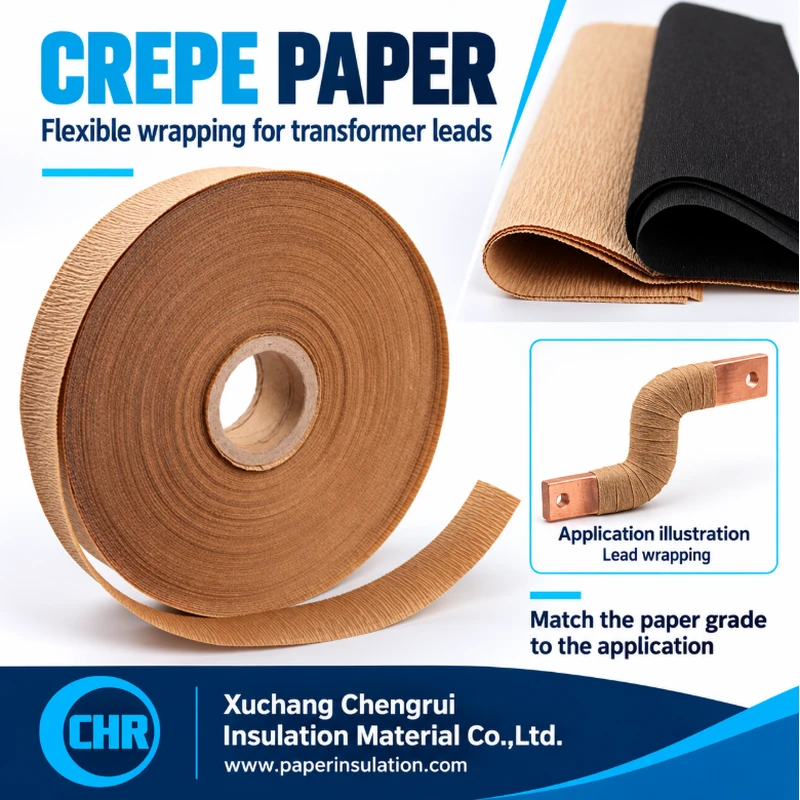
Crepe-paper supply forms and a lead-wrapping application illustration. Colour alone does not identify the electrical grade.
Crepe Paper Tape or Tubes: Which Form Should You Evaluate?
Crepe paper tubes are supplied as formed sleeves; slit rolls and tapes are supplied for wrapping. Neither form is automatically the right choice for every lead.
| Lead or assembly condition | Form to evaluate | Detail to confirm before ordering |
|---|---|---|
| Bend or changing conductor cross-section | Slit crepe paper tape | Tape width, access for wrapping and finished insulation build |
| Lead section that can accept a sleeve | Crepe paper tube | Inside diameter, wall thickness, length and assembly clearance |
| Connection with a larger terminal or joint | Form selected for the actual installation sequence | Whether a sleeve can pass over the connection, or local wrapping is required |
| Repeated lead geometry in production | Either form, assessed on a representative sample | Repeatable fit, handling and acceptance criteria |
For tape, the width must suit both the shape and the wrapping process. A width that works on a straight section may be awkward around a tight change in direction. In this article, “tape” means a narrow strip of crepe paper; it does not imply an adhesive backing.
For a tube, nominal inside diameter is only the starting point. Check the actual conductor profile, the route used to install the tube and the space remaining after assembly. Include tolerances on the drawing rather than relying on a description such as “fits our standard lead.”
Three Application Points to Check
1. Bends and Changes in Direction
Evaluate a sample on the actual bend geometry. Look for tears, gaps, bunching or areas where the paper has been pulled unevenly. Check the finished outside dimensions where the insulated lead passes close to other parts.
Crepe paper's ability to conform should not be treated as permission to stretch it without control. Set wrapping tension, overlap and insulation build through the approved manufacturing procedure.
2. Joints, Terminals and Section Changes
A joint can create a local increase in conductor size. The insulation drawing should address this transition and define how the connection area is covered.
For purchasing, the useful question is whether the supplied tape or tube can be installed in the planned assembly sequence. A sample should represent the connection geometry, not only a straight piece of conductor.
3. Drying, Handling and Oil Impregnation
Confirm how the selected paper grade and assembled insulation will be handled, dried and incorporated into the transformer's oil-paper system. Use the manufacturer's validated process and grade-specific requirements; a general blog cannot define a universal drying temperature or cycle.
Keep incoming material identified and protected according to the agreed storage instructions. Record the batch used for the production trial so an accepted sample can be linked to repeat orders.
Black Crepe Paper Needs a Separate Grade Check
Do not use colour as the acceptance criterion. Chengrui lists semi-conductive black crepe paper for electrical-field control and shielding. That function differs from primary dielectric insulation.
The black material shown in the supplied graphic cannot be assigned a grade from its appearance. Confirm whether the drawing calls for insulating paper or a separately specified semi-conductive material before selecting or substituting it.
What to Include in a Crepe Paper Enquiry
A useful enquiry connects the material specification to the part being insulated.
| Information to provide | Why it matters |
|---|---|
| Application position and drawing | Identifies the lead, bend, joint or sleeve location |
| Material grade and electrical function | Separates dielectric insulation from semi-conductive shielding |
| Tape dimensions | Defines thickness, width, tolerances and required roll format |
| Tube dimensions, if required | Defines inside diameter, wall thickness, length and tolerances |
| Assembly and process requirements | Identifies installation access and relevant drying or impregnation conditions |
| Quantity, packaging and inspection requirements | Supports a quotation and an agreed delivery specification |
Before approving a bulk order, agree what a representative sample must demonstrate: fit on the intended lead, acceptable finished dimensions, suitable handling and the required material documentation. Acceptance should follow the approved drawing and test requirements.
Frequently Asked Questions
What is crepe paper used for on transformer leads?
It provides conformable paper-based insulation around leads and connection areas in the specified insulation design. The selected grade and finished insulation build must match the application.
Is crepe paper tape better than a crepe-paper tube?
The choice depends on geometry and installation access. Tape can be evaluated for local wrapping; a tube can be evaluated where a formed sleeve fits the lead and assembly sequence. Confirm the choice with a representative sample.
How many layers of crepe paper are required?
There is no universal layer count. The electrical design and manufacturing specification must define the required insulation build, wrapping arrangement and acceptance tests. Supply voltage alone is not enough to specify a wrap.
Can black crepe paper replace brown insulating crepe paper?
Only if the specified grade and electrical function are suitable. Some black crepe papers are semi-conductive shielding materials, so colour or similar appearance is not evidence of interchangeability.
Discuss Your Lead-Insulation Requirement with Chengrui
Chengrui supplies electrical-grade crepe paper in rolls, slit rolls, tapes and tubes. For your next enquiry, include the application position, material grade, required dimensions, quantity and any relevant drawing.
Contact Chengrui to discuss the available supply form and the specification needed for your order.


Quick Quote