The Complete Guide to 6 Types of Motor Insulation
Electric motors are found in virtually every industrial facility, from small fractional-horsepower motors to massive turbine generators. Yet the component that determines motor reliability and lifespan is often overlooked: the insulation system. A motor with excellent copper windings but poor insulation will fail prematurely. Conversely, a well-designed insulation system can extend motor life by decades.
The motor insulation system is not a single layer, but a sophisticated multi-layered structure comprising six distinct insulation types, each serving a specific electrical isolation function. Understanding these six types—and how to select appropriate materials for each—is essential for motor manufacturers, engineers, importers, and maintenance professionals.
This comprehensive guide breaks down all six insulation types, explains their functions and provides practical material selection guidance for different motor applications.
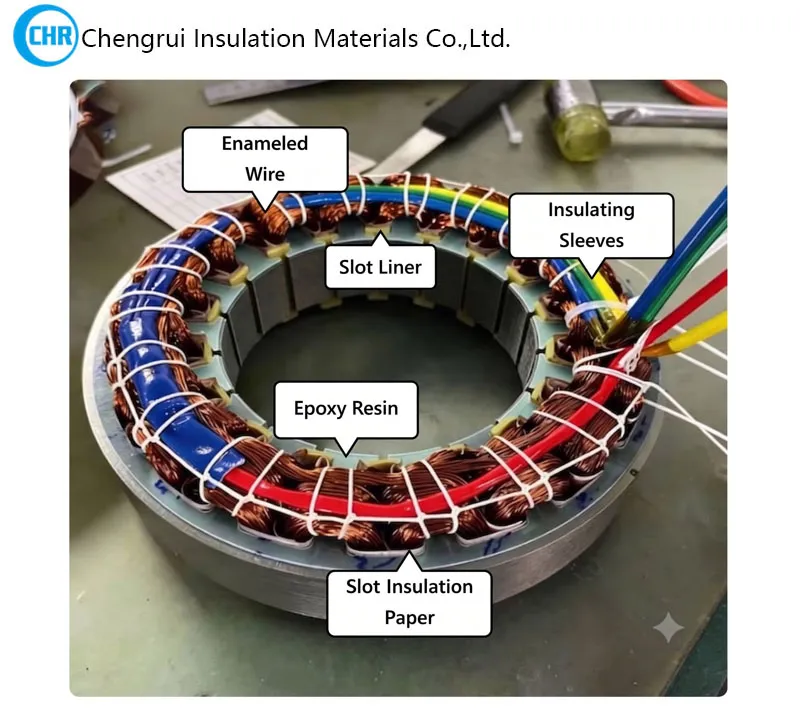
Overview: The Six-Layer Insulation System
1. Interstrand Insulation (股间绝缘)
Definition and Location
Interstrand insulation refers to the insulation between individual copper strands within a single conductor. In modern motor design, copper conductors are typically composed of multiple fine strands twisted together (stranded wire) to reduce skin effect losses at high frequencies. Interstrand insulation is the enamel coating on each individual copper strand.
Electrical Stress
Voltage difference between strands: <1V (extremely low)
Primary stress source: High-frequency eddy currents and thermal stress, not electrical voltage
Significance: In normal operation, interstrand insulation experiences the lowest electrical stress of all six insulation types
Thickness and Materials
Typical thickness: 20-50 micrometers (μm)
Applications: All motor windings (low-voltage, high-voltage, synchronous, asynchronous motors), especially large-power and high-speed motors.
2. Turn-to-Turn Insulation (匝间绝缘)
Definition and Location
Turn-to-turn insulation is the insulation between adjacent turns within the same coil. In motor windings, copper wire is wound into coils, with each complete loop around the coil former called a "turn." Turn-to-turn insulation prevents short circuits between adjacent turns.
Electrical Stress
Voltage difference between turns: 10-50V (low)
Variation: In high-voltage motors, turn-to-turn voltage can exceed 100V
Stress type: Primarily electrical stress from voltage difference between turns
Thickness and Materials
Typical thickness: 0.05-0.15 mm
| Material | Thickness | Thermal Class | Properties |
| Copper wire enamel coating | 20–50 μm | B/F/H | Base insulation layer |
| Insulation paper wrapping | 0.05–0.1 mm | F | Supplementary isolation |
| Insulation tape | 0.05–0.1 mm | F/H | Additional protection |
| Composite insulation paper (DMD/NMN) | 0.1–0.15 mm | F/H |
Applications: All motor windings, especially high-speed motors and high-temperature motors where vibration and thermal stress are significant.
3. Phase-to-Phase Insulation (相间绝缘)
Definition and Location
Phase-to-phase insulation is the insulation between different phase windings (A phase, B phase, C phase) in three-phase motors. In three-phase induction or synchronous motors, the stator winding consists of three independent phase windings arranged in an interleaved pattern within the same iron core slots. Phase-to-phase insulation prevents short circuits between different phase windings.
Electrical Stress
Voltage difference between phases: Approximately equal to line voltage (380V, 440V, 3000V, etc.)
Peak phase-to-phase voltage: U_line × sin(θ) ≈ U_line (at certain moments)
Significance: Phase-to-phase insulation experiences electrical stress comparable to or even exceeding ground insulation
Thickness and Materials
Low-voltage motors (≤1000V):
| Design | Thickness | Material |
| Economy | 0.15–0.2 mm | DMD or 6520 insulation paper |
| Standard | 0.2–0.25 mm | NMN or DMD insulation paper |
| High-reliability | 0.25–0.35 mm | NHN or AHA insulation paper |
| High-temperature | 0.25–0.35 mm | NHN or mica paper |
High-voltage motors (>1000V): Mainly mica products, mica composite material
Applications: All three-phase motors (low-voltage, medium-voltage, high-voltage), especially critical applications where motor reliability is essential.
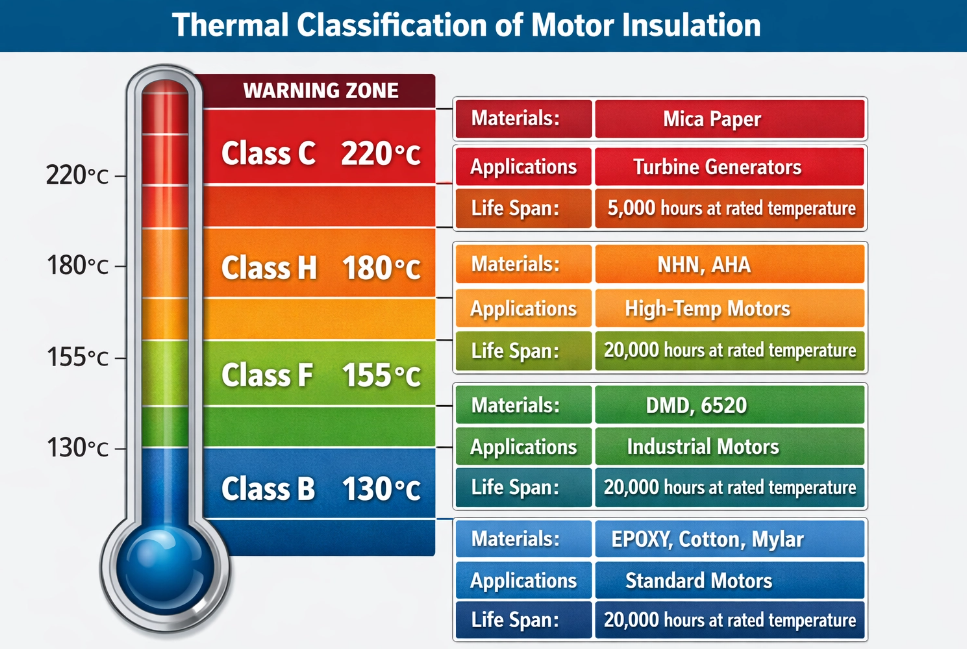
4. Coil-to-Coil Insulation (排间绝缘)
Definition and Location
Coil-to-coil insulation (also called intercoil insulation) is the insulation between parallel conductor strands or coil groups. In high-power motors, multiple conductors are often connected in parallel to increase current capacity. These parallel conductors are referred to as "coil groups," and coil-to-coil insulation prevents short circuits between them.
Electrical Stress
Voltage difference between coil groups: 50-200V (medium)
Variation: Uneven current distribution among parallel conductors can create localized voltage peaks
Stress type: Electrical stress from voltage imbalance
Thickness and Materials
| Material | Thickness | Thermal Class |
| DMD insulation paper | 0.15–0.25 mm | F (155°C) |
| NMN insulation paper | 0.15–0.25 mm | F/H (155–180°C) |
| NHN insulation paper | 0.15–0.25 mm | H (180°C) |
| Polyester tape | 0.1–0.2 mm | F (155°C) |
| Polyimide tape | 0.1–0.2 mm | H (180°C) |
Applications: High-power low-voltage motors (>10 kW), high-speed motors, motors with parallel winding designs.
5. Layer-to-Layer Insulation (层间绝缘)
Definition and Location
Layer-to-layer insulation is the insulation between multiple coil layers within the same motor slot. To maximize slot utilization, motor designers often stack multiple coil layers vertically within a single slot. Layer-to-layer insulation prevents short circuits between these layers.
Electrical Stress
Voltage difference between layers: 50-200V (medium)
Stress distribution: Relatively uniform across the insulation layer
Stress type: Electrical stress from voltage difference between layers
Thickness and Materials
| Material | Thickness | Thermal Class |
| DMD insulation paper | 0.15–0.25 mm | F (155°C) |
| NMN composite paper | 0.15–0.25 mm | F/H (155–180°C) |
| NHN composite paper | 0.15–0.25 mm | H (180°C) |
| Insulation board | 0.2–0.4 mm | F/H (155–180°C) |
| Fiberglass-reinforced cloth | 0.2–0.4 mm | F/H (155–180°C) |
Applications: All multi-layer winding motors, especially medium to large motors (>5 kW) and high-speed motors where vibration is significant.
6. Ground Insulation (Main Insulation) (对地绝缘)
Definition and Location
Ground insulation (also called main insulation) is the insulation between the motor winding and the motor frame/iron core. This is the most critical insulation layer in the entire motor insulation system, directly bearing the full line voltage stress. Ground insulation failure results in leakage current to the motor frame, creating serious safety hazards (electric shock) and motor burnout.
Electrical Stress
Voltage stress: Equal to the working line voltage (380V, 440V, 3000V, etc.)
Significance: Highest electrical stress of all six insulation types
Safety-critical: Failure can cause electric shock and serious accidents
Thickness and Materials
Low-voltage motors (≤1000V):
| Design | Thickness | Material | Thermal Class |
| Economy | 0.18–0.2 mm | DMD or 6520 paper | F (155°C) |
| Standard | 0.2–0.25 mm | NMN or DMD paper | F/H |
| High-reliability | 0.25–0.32 mm | NHN or AHA paper | H (180°C) |
| High-temperature | 0.3–0.5 mm | NHN or mica paper | H/C |
Applications: All motors, especially high-voltage motors, high-temperature motors, and motors operating in harsh environments.
Insulation Material Specifications
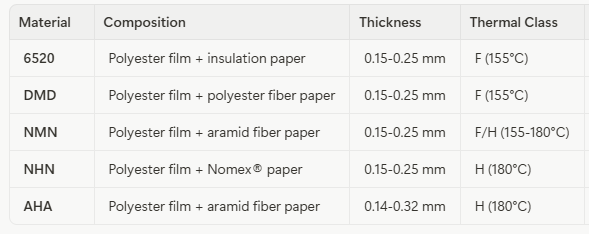
Composite Insulation Papers for Low-Voltage Motors
Conclusion
The six-layer motor insulation system represents a sophisticated engineering solution to protect electrical equipment from failure. Each layer serves a specific function, and failure in any single layer can cascade into complete motor failure. Understanding these six insulation types—and selecting appropriate materials for each—is essential for designing reliable, long-lasting motors.
Key Takeaways:
1.All six insulation types are essential: No single layer can be compromised without risking motor failure
2.Voltage stress varies by layer: Phase-to-phase and ground insulation experience the highest stress
3.Material selection is critical: Different motor types and operating conditions require different material combinations
4.Quality control is essential: Proper testing and inspection ensure insulation reliability
FAQ
Q: What is the difference between phase-to-phase and ground insulation?
A: Ground insulation isolates the winding from the motor frame (grounded), while phase-to-phase insulation isolates different phase windings from each other. Both experience high electrical stress and are equally important.
Q: Why is turn-to-turn insulation important if the voltage difference is only 10-50V?
A: Even though the voltage difference is low, turn-to-turn short circuits create circulating currents that generate significant heat and magnetic field distortion, ultimately leading to winding failure.
Q: Can I use the same insulation material for all six layers?
A: While theoretically possible, it is not practical or economical. Different layers experience different stresses and have different space constraints. Optimized designs use different materials for different layers.
Q: What insulation materials are best for high-temperature motors?
A: For Class H (180°C) motors: NHN or AHA composite paper. For Class C (220°C) motors: mica paper composites with epoxy resin impregnation.


Quick Quote