BOPET vs. PET Film: The Difference? | Industrial Guide
If you are a procurement manager sourcing raw materials for transformer manufacturing, motor winding, or flexible packaging, you have likely seen the terms PET film and BOPET film used interchangeably.
This often leads to a common industrial sourcing question: Are they exactly the same thing?
The Short Answer:
Chemically, yes; structurally, no.
PET (Polyethylene Terephthalate) is the overarching name of the raw polymer resin. BOPET (Biaxially Oriented PET) refers to a specific, highly advanced manufacturing process that stretches the PET film in two directions to give it extreme mechanical strength and thermal stability.
In the heavy-duty electrical insulation industry, when engineers ask for "Polyester Film," they are almost exclusively referring to BOPET film.
Here is a deep dive into the technical differences, manufacturing processes, and why understanding this distinction is critical for your supply chain.
1. What is PET Film? (The Base Material)
PET stands for Polyethylene Terephthalate. It is a highly versatile, thermoplastic polymer resin of the polyester family. Whenever a film is extruded using this specific resin, it is technically a "PET film."
However, if the film is just extruded and cooled without any further stretching, it lacks high tensile strength. Depending on how it is processed, standard PET is typically categorized into:
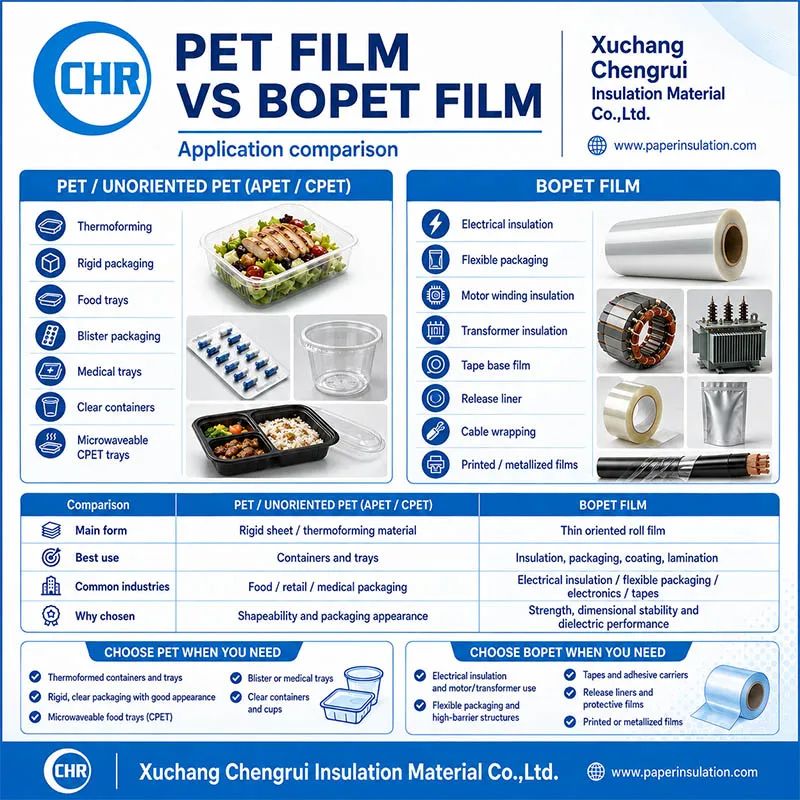
APET (Amorphous PET): Highly transparent and flexible, but cannot withstand high temperatures. Primarily used for retail blister packaging (e.g., clear plastic fruit containers).
CPET (Crystalline PET): Opaque and heat-resistant, commonly used for microwaveable food trays.
Neither of these un-oriented films possesses the structural rigidity or dielectric strength required for industrial electrical applications.
2. What is BOPET Film? (The Advanced Process)
BOPET stands for Biaxially Oriented Polyethylene Terephthalate. This is not a different chemical material; rather, it is the ultimate engineered state of PET film.
To create BOPET, the extruded PET polymer is fed into a massive stenter frame machine where it undergoes Biaxial Orientation:
2.1 Machine Direction (MD): The film is pulled forward lengthwise over heated rollers.
2.2 Transverse Direction (TD): The film is simultaneously gripped at the edges and stretched sideways.
Why does this matter? This bidirectional stretching forces the random polymer chains to align perfectly into a tightly packed grid. This molecular alignment completely transforms the physical properties of the plastic, locking in exceptional tensile strength, chemical resistance, and voltage endurance.
3. Quick Comparison: Standard PET vs. BOPET Film
To help your engineering team make the right specification choices, here is a breakdown of how the stretching process changes the material:
| Feature / Property | Standard PET Film (Un-oriented / APET) | BOPET Film (Biaxially Oriented) |
| Manufacturing Process | Simple extrusion and cooling | Extrusion + Dual-direction stretching |
| Mechanical Strength | Low to moderate; stretches easily | Extremely high tensile strength; resists tearing |
| Thermal Stability | Shrinks or deforms easily under heat | Highly stable; minimal shrinkage at high temps |
| Dielectric Strength | Inconsistent for high voltage | Premium voltage breakdown resistance |
| Primary Applications | Retail food packaging, thermoforming | Electrical motor insulation, FPC, cable wrapping |
4. Why BOPET is the Standard for Electrical Insulation
For manufacturers of oil-immersed transformers and high-voltage motors, substituting true BOPET film with inferior polyester variants is a recipe for catastrophic equipment failure.
Here is why BOPET is the undisputed standard for Class E (120°C) and composite insulation:
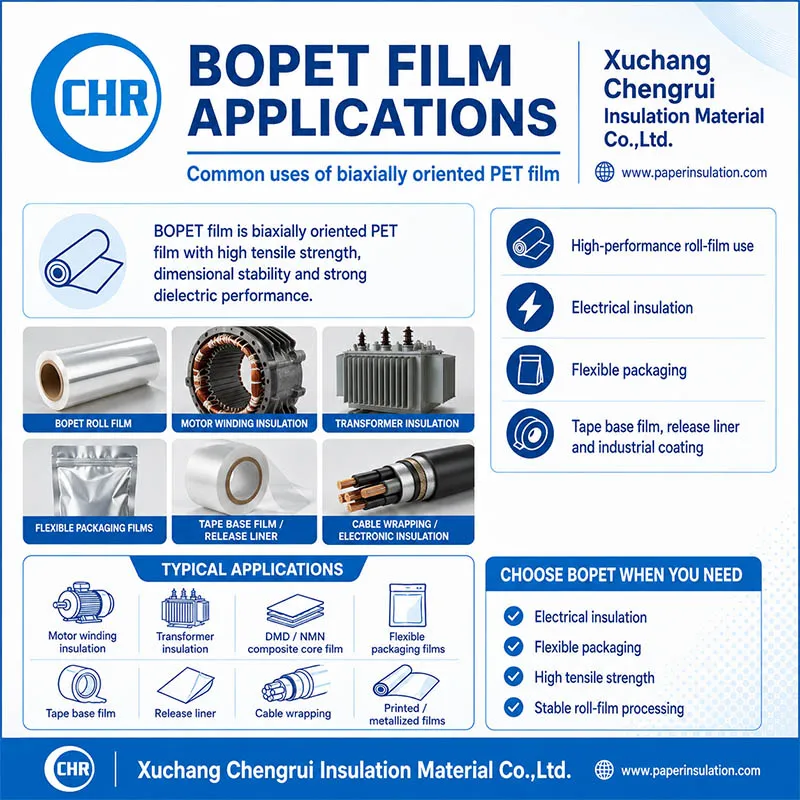
Flawless Machinability: High-speed automated motor winding machines exert immense tension on insulation materials. BOPET's high tensile strength ensures the film will not snap, tear, or warp during rapid slot insertion.
The Core of Composite Papers: BOPET acts as the vital dielectric core layer in premium flexible composite materials like DMD (Dacron/Mylar/Dacron) Paper and NMN (Nomex/Mylar/Nomex) Paper. The outer non-woven layers absorb resins, while the inner BOPET layer blocks voltage breakdowns.
Thermal Endurance: Inside an active transformer, temperatures fluctuate wildly. BOPET maintains its dimensional stability and physical integrity without melting or severe shrinkage, protecting the copper coils from short circuits.
5. Global Wholesale Sourcing for Industrial Manufacturers
Since 2010, Chengrui Insulation has been at the forefront of manufacturing and exporting industrial-grade electrical insulation materials. We understand that global transformer and motor factories require strict adherence to IEC standards and massive, uninterrupted supply lines.
Chengrui Insulation Material Co.,Ltd operate exclusively as a direct industrial supplier. To maintain our highly competitive factory-direct pricing and ensure maximum logistical efficiency, our Minimum Order Quantity (MOQ) is a 1 ton.
Custom Slitting: We provide master rolls and precision-slit tapes (down to tight ±0.1mm tolerances) tailored to your automated production lines.
Mixed Containers: You can optimize your logistics by mixing BOPET films with our other rigid and flexible insulation products (such as DMD paper, DPC paper, and phenolic bakelite boards) within a single container shipment.
Ready to upgrade your insulation supply chain?
Visit www.paperinsulation.com to submit your technical specifications, or contact our engineering sales team directly to secure a wholesale quotation for your next production quarter.


Quick Quote