Black Crepe Paper for Transformer: What a Buyer Should Really Check Before Buying
If you manufacture oil-filled transformers, you already know that not every insulation material causes problems in the same way.
Some materials fail electrically.
Some fail mechanically.
Some look fine on paper, but become difficult to use once they reach the winding shop.
Black crepe paper belongs to a category of materials that is often underestimated. On the quotation sheet, it looks simple. In real transformer production, it is not.
For transformer manufacturers, the question is usually not:“What is black crepe paper?”
The real questions are:
Will it wrap smoothly around leads and irregular parts?
Will it stay stable after oil impregnation?
Is the creping uniform enough for workshop use?
Is the thickness suitable for our insulation build?
Is it the right material for this point in the transformer, or should we use another paper?
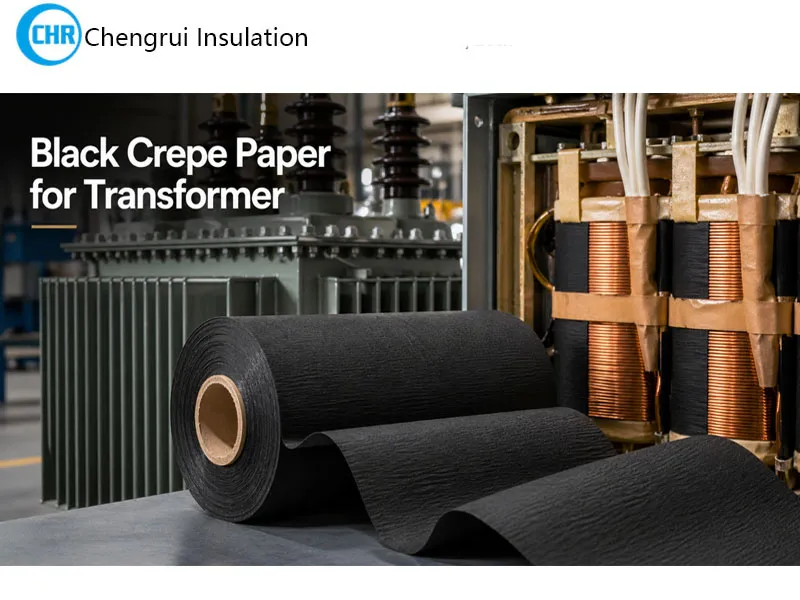
What Is Black Crepe Paper in Practical Transformer Use?
Black crepe paper is a flexible electrical insulation paper with a creped structure, used mainly where the transformer design includes curved, uneven or difficult-to-wrap parts.
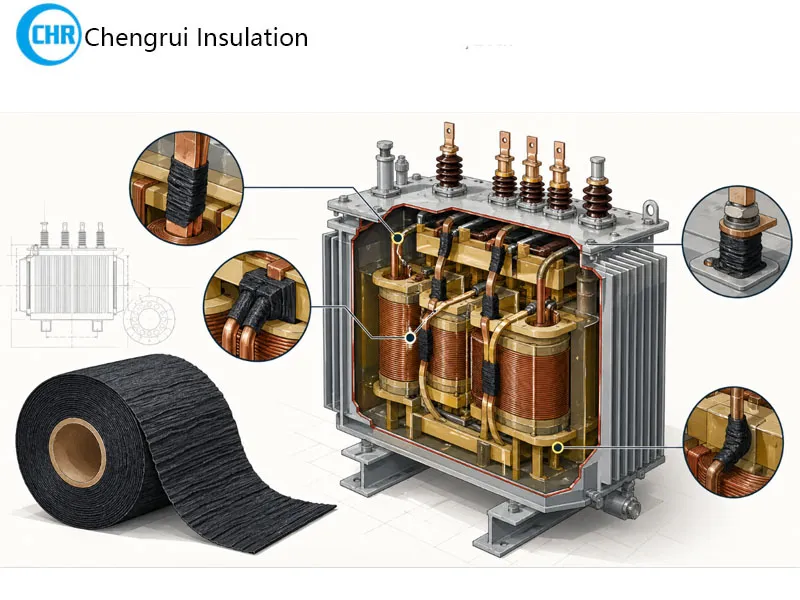
In practice, transformer manufacturers usually use it for:
lead wrapping
conductor covering
edge and corner insulation
local insulation in oil-filled transformers
positions where flat paper does not fit well
That is the first point to be clear about:
black crepe paper is not usually chosen because it is black. It is chosen because it is creped.
The black color may help with identification, internal material distinction, or customer preference, but from a manufacturing point of view, the value is in the material's flexibility, conformity and handling behavior.
Where Transformer Manufacturers Actually Use It
In many inquiries, buyers describe black crepe paper too generally. They say they need it “for transformer insulation.” That is not enough.
To choose the right grade, you need to be more specific.
1 Lead Insulation
This is one of the most common uses. Transformer leads are rarely perfect flat surfaces. They bend, cross, turn and exit at difficult angles. Crepe paper is used because it wraps more naturally than ordinary flat insulation paper.
2 Covering Round or Irregular Conductors
If the conductor shape is not easy to cover with rigid or flat material, crepe paper is often the more practical option.
3 Corner and Transition Areas
Some insulation failures do not start in the main winding body. They start in local transition points where material fit is poor. Black crepe paper is often used in these areas because it adapts better to the real shape.
4 Oil-Filled Transformer Local Insulation
In oil-filled transformers, local paper insulation must not only fit mechanically, but also behave properly in the oil-paper insulation system. This is where material quality matters much more than many buyers expect.
So before purchasing, the first thing a transformer manufacturer should ask is:
Where exactly will this crepe paper be used?
Not “What is your best price?”
Not even “What thickness do you have?”
The first question is always the position inside the transformer.
What Buyers Should Really Check Before Buying
This is where many purchases go wrong.
A supplier may send a quotation with width, thickness and price.
That is not enough to judge whether the material is right for your production.
Here are the points that actually matter.
1 Creping Uniformity
If the crepe is inconsistent, the paper may behave differently during wrapping. One roll may stretch more, another may resist more, and workshop handling becomes unstable.
For transformer manufacturers, this affects:
wrapping efficiency
consistency between workers
fit on bends and corners
local insulation quality
2 Flexibility and Stretchability
The paper must conform to the part without breaking, lifting or creating poor contact areas.
If the material is too stiff, it defeats the purpose of using crepe paper in the first place.
3 Thickness
This is not just a number. Thickness affects:
insulation build
wrapping behavior
number of layers needed
fitting around tight areas
final space control in assembly
A paper that is too thin may not build insulation properly.
A paper that is too thick may become difficult to wrap cleanly.
4 Oil Compatibility
If the paper is used in oil-filled transformers, compatibility with the oil-paper system matters. The material should behave well after impregnation and not create unnecessary uncertainty in the insulation structure.
5 Roll Width and Workshop Convenience
This is often overlooked. A width that looks fine in theory may create unnecessary cutting waste or inconvenience in actual production.
A serious buyer should check:
standard roll width
slit width options
whether the roll width matches workshop use
whether the material will be hand-applied or machine-assisted
Black Crepe Paper vs Flat Insulation Paper
This is one of the most useful comparisons for transformer manufacturers.
Flat Insulation Paper
Better for:
regular flat surfaces
simple layer insulation
easier dimensional control in straightforward areas
Black Crepe Paper
Better for:
curved surfaces
leads
corners
conductor wrapping
local irregular insulation points
The decision is not about "which paper is better."
The decision is:
Does this transformer part require conformity or not?
If yes, crepe paper is often the more practical material.
Black Crepe Paper vs Diamond Dotted Paper
This comparison also matters in real transformer purchasing.
Black Crepe Paper
Main function:
flexible wrapping
irregular insulation coverage
Main function:
interlayer insulation
bonding and winding stability
If a transformer manufacturer uses black crepe paper where the winding actually needs bonding, the result may be poor winding stability.
If DDP is used where flexibility and shape adaptation are required, the result may be poor wrapping efficiency.
The two materials are both paper-based transformer insulation materials, but they solve different production problems.
Common Purchasing Mistakes
These are the mistakes we see most often.
Mistake 1: Buying by color
Black is not the key point. Creping quality and base paper quality matter far more.
Mistake 2: Not defining the actual application point
“Used in transformer” is too vague. The exact insulation point must be clear.
Mistake 3: Choosing only by low price
A cheaper roll may cost more later if it wraps badly, wastes labor time or creates inconsistent fitting.
Mistake 4: Using crepe paper where another paper is more suitable
Crepe paper is for flexibility. It is not the right answer for every insulation position.
Mistake 5: Ignoring workshop feedback
A material that looks fine on a data sheet may not perform well in manual wrapping or production handling.
This is why good transformer buyers often involve both:
technical staff
workshop users
before final approval.
FAQ:
Q1:What is black crepe paper mainly used for in transformers?
A:Mainly for lead wrapping, conductor covering, corner insulation and other local insulation points where flexibility is required.
Q2:Is black crepe paper suitable for oil-filled transformers?
A:Yes, it is commonly used in oil-filled transformer applications, especially for local wrapping and irregular insulation points.
Q3:Is black crepe paper better than ordinary insulation paper?
A:Not in every case. It is better where flexibility and shape conformity are important. For flat and regular areas, ordinary insulation paper may still be more practical.
Q4:Can black crepe paper replace diamond dotted paper?
A:No. Crepe paper is mainly for wrapping and fitting. Diamond dotted paper is mainly for interlayer bonding and winding stability.
Final Thoughts
For transformer manufacturers, black crepe paper is not a complicated material, but it is a material that should be selected with care.
Its value is very practical:
it wraps where flat paper does not
it fits where rigid material struggles
it helps solve local insulation problems in real transformer production
But it only works well when it is used in the right place.
So the key question is not:Do I need black crepe paper?
The better question is:
“Do I have a transformer insulation point that requires flexibility, conformity and easy wrapping?”
If the answer is yes, black crepe paper is often the right material to evaluate.
If you are sourcing black crepe paper for transformer manufacturing, we can help you evaluate the right thickness, roll width and application fit based on your actual transformer structure and workshop use.
Contact us for technical discussion, sample support or quotation.


Quick Quote