NMN or NHN: How to Choose the Right Insulation Paper?
When buyers compare NMN insulation paper and NHN insulation paper, they are usually trying to solve a practical problem:
Which insulation paper is more suitable for my motor, generator, transformer or electrical equipment?
At first glance, the two materials look similar. Both are flexible laminated insulation papers with Nomex® paper on the outer layers. Both are used in electrical insulation systems. But they are not the same material, and they are not selected for exactly the same thermal requirements or cost targets. Your product pages define them with different center films:
NMN = Nomex / polyester film / Nomex
NHN = Nomex / polyimide film / Nomex
That difference is the starting point for everything else.
In simple terms:
NMN is usually the more practical mainstream choice.
NHN is usually the stronger choice for higher-temperature insulation systems.
This article explains the difference from the perspective of raw material, temperature class, application, price and purchasing decisions.
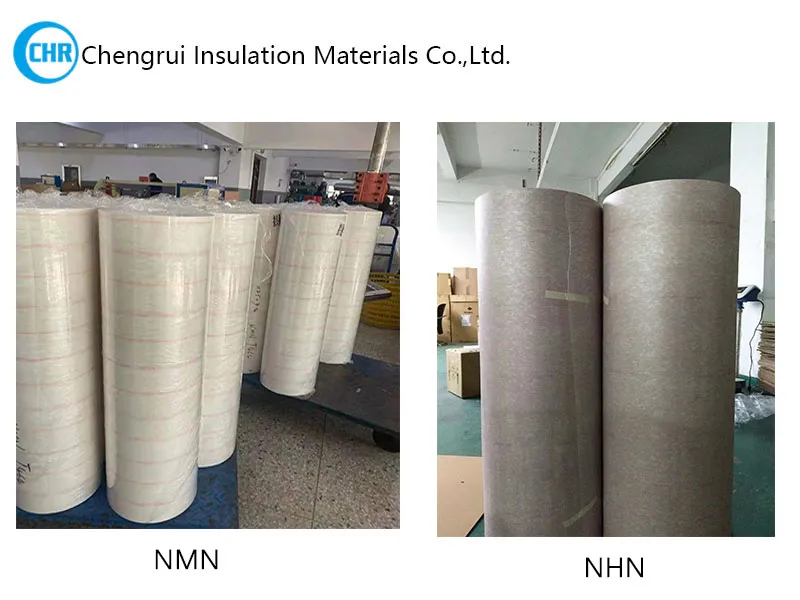
Raw Material: What NMN and NHN Are Made Of
The most important structural difference between NMN and NHN is the film in the middle.
NMN structure
NMN stands for:
Nomex® aramid paper
Mylar / polyester film
Nomex® aramid paper
NHN structure
NHN stands for:
Nomex® aramid paper
High-temperature film, here polyimide film
Nomex® aramid paper
NHN also called NKN (Nomex + Kapton film + Nomex)
That means the raw material difference is not minor.
The outer layers are similar, but the center film is different, and that directly affects thermal position, cost and application choice.
Temperature Class: 155°C vs 180°C
This is the second major difference.
IEC 60085 is the standard that establishes the evaluation and designation of thermal classes for electrical insulating materials and systems. Under this framework, Class F corresponds to 155°C and Class H corresponds to 180°C.
From a buyer's point of view, the practical takeaway is:
if the application is clearly Class H (180°C) and high-temperature capability is a key requirement, NHN is usually the safer choice
if the application is Class F or a more cost-sensitive high-performance application, NMN is often the more practical material to evaluate first
Uses and Applications
Typical uses of NMN
NMN insulation paper for:
slot liner
slot closure
phase-to-phase insulation
turn-to-turn insulation
interlayer insulation in transformers and other electrical machines
That makes NMN a common candidate for:
low- and medium-voltage motors
industrial motors
general electrical machines
transformer interlayer insulation applications where the system design allows it
Typical uses of NHN
NHN insulation paper for:
slot insulation in Class H motors
electric insulation
turn-to-turn insulation
padding
Class H interlayer spacing of dry-type transformer insulation
That means NHN is more suitable when the application is more explicitly linked to Class H and higher-temperature working conditions.
Price Difference
In actual purchasing, NHN is usually more expensive than NMN.
The reason is straightforward:
polyimide film is generally a higher-performance and higher-cost material than polyester film. Since NHN is built around a polyimide film core, its material cost is usually higher.
That is why the decision between NMN and NHN is often not only technical, but also commercial:
if the application can be handled by NMN, many buyers prefer NMN because it delivers strong insulation performance at a lower cost
if the application clearly requires stronger Class H high-temperature performance, NHN is usually worth the extra cost
This is one of the most practical parts of the NMN vs NHN decision, even though exact price differences will vary by thickness, brand and purchase volume.
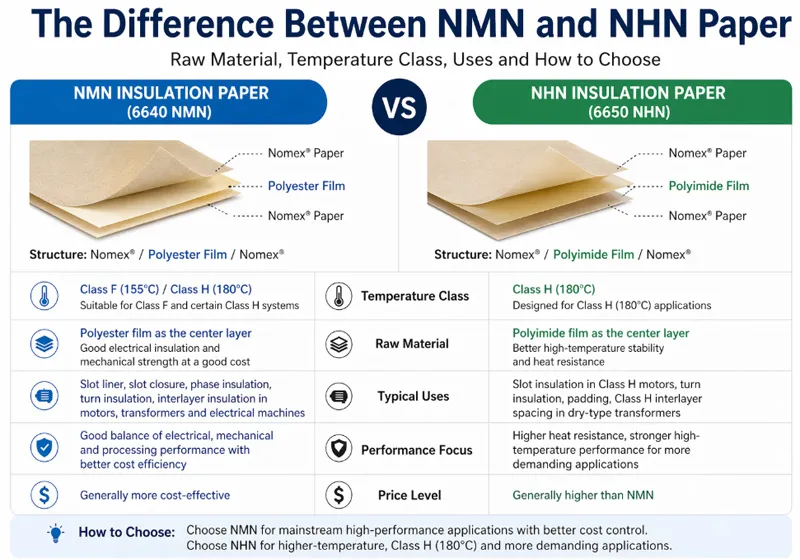
Which One Should You Choose?
A practical selection method is:
Choose NMN if:
the application is Class F or certain Class H systems
you need strong overall performance with better cost control
the motor or electrical machine does not require the higher-temperature film system of NHN
the application includes slot liner, phase insulation, turn insulation or interlayer insulation in mainstream industrial equipment
Choose NHN if:
the system is clearly designed around Class H (180°C)
the operating temperature is higher
the application is more demanding
you want the structural advantage of a Nomex / polyimide / Nomex laminate
long-term thermal margin is more important than minimizing material cost
In simple words:
Choose NMN for mainstream high-performance applications.
Choose NHN for more demanding high-temperature applications.
FAQ
Q1:What is the difference between NMN and NHN paper?
A: The main difference is the center film layer. NMN uses polyester film, while NHN uses polyimide film. That difference affects thermal class, application range and price.
Q2:Which one has better heat resistance, NMN or NHN?
A: NHN generally has the clearer higher-temperature position because your NHN page identifies it as Class H (180°C), while your NMN page is positioned for Class F / Class H system use depending on grade and application.
Q3: Is NMN cheaper than NHN?
A: In general, yes. NHN is usually more expensive because it uses polyimide film, which is typically a higher-cost material than polyester film.
Q4: Is NHN always better than NMN?
A: No. NHN is usually better for higher-temperature applications, but NMN is often the more practical choice when buyers want strong insulation performance with better cost efficiency.
Final Thoughts
The difference between NMN and NHN paper starts with raw material structure:
NMN = Nomex / polyester film / Nomex
NHN = Nomex / polyimide film / Nomex
From there, the differences extend to:
temperature class
application focus
price
buyer selection logic
If the goal is a practical and cost-effective insulation material for many mainstream electrical applications, NMN is often the right material to evaluate first.
If the goal is stronger Class H thermal performance and a higher-temperature insulation system, NHN is usually the better choice.
The best decision depends on the actual application, not just the material name.


Quick Quote