Silicone Fiberglass Sleeving vs Silicone Rubber Fiberglass Sleeving
Silicone fiberglass sleeving and silicone rubber fiberglass sleeving are both widely used for electrical insulation and wire protection applications.
Although they look similar and share a fiberglass reinforcement structure, they are designed for different working conditions.
The main difference is:
Silicone fiberglass sleeving provides stronger dimensional stability and reliable electrical insulation protection, while silicone rubber fiberglass sleeving offers better flexibility and resistance to vibration and movement.
For fixed electrical connections, motor leads and transformer wiring, silicone fiberglass sleeving is often preferred.
For applications requiring frequent bending, movement or higher flexibility, silicone rubber fiberglass sleeving may be a better choice.
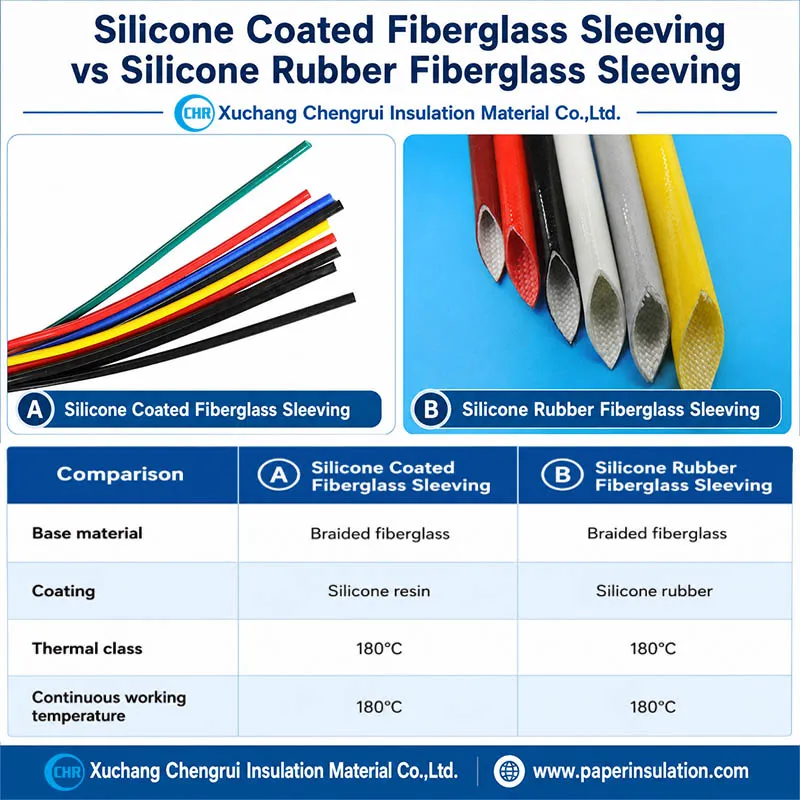
Silicone Fiberglass Sleeving vs Silicone Rubber Fiberglass Sleeving Comparison
| Item | Silicone Fiberglass Sleeving | Silicone Rubber Fiberglass Sleeving |
| Base Material | Braided fiberglass | Braided fiberglass |
| Coating Material | Silicone resin coating | Silicone rubber coating |
| Insulation Class | Class H | Class H |
| Breakdown Voltage | 2.5kV / 4kV / 7kV options | 2.5kV / 4kV / 7kV options |
| Flexibility | Medium flexibility | Higher flexibility |
Key Difference 1: Coating Structure and Material Design
The biggest difference between silicone fiberglass sleeving and silicone rubber fiberglass sleeving comes from the coating layer.
Silicone Fiberglass Sleeving
Silicone fiberglass sleeving uses a fiberglass braided tube coated with silicone resin.
This structure provides:
Good insulation performance
Stable shape after installation
Good abrasion resistance
Reliable protection for electrical wiring
It is suitable for applications where the sleeve needs to stay in position and provide long-term insulation protection.
Common applications:
Motor lead wires
Transformer internal wiring
Generator connections
Electrical cabinets
Silicone Rubber Fiberglass Sleeving
Silicone rubber fiberglass sleeving uses a fiberglass braid covered with silicone rubber.
The rubber coating creates a softer and more flexible sleeve.
Main advantages:
Better bending performance
Better vibration resistance
More flexible installation
Softer surface protection
It is suitable for applications where cables move or experience mechanical stress.
Common applications:
Automotive electrical systems
Flexible cable connections
Equipment with vibration
Moving electrical components
Key Difference 2: Flexibility and Mechanical Performance
Flexibility is one of the most important factors when selecting electrical insulation sleeving.
When Silicone Fiberglass Sleeving Is Better
Choose silicone fiberglass sleeving when:
The wire position is fixed
Stable insulation protection is required
The sleeve needs to maintain its shape
The application requires good mechanical strength
Examples:
Motor winding lead protection
Transformer connection wires
Industrial electrical equipment
When Silicone Rubber Fiberglass Sleeving Is Better
Choose silicone rubber fiberglass sleeving when:
The cable moves frequently
Vibration is present
The installation space is limited
The sleeve needs repeated bending
Examples:
Automotive wiring
Flexible electrical assemblies
Robotic equipment
Moving machinery
Key Difference 3: Temperature Resistance and Electrical Insulation
Both silicone fiberglass sleeving and silicone rubber fiberglass sleeving are designed for high-temperature electrical insulation applications.
Typical characteristics include:
High heat resistance
Good dielectric properties
Flame retardant performance
Protection against electrical stress
For high-temperature motors, transformers and generators, Class H insulation sleeving is commonly selected.
However, temperature resistance alone should not decide the material choice.
Engineers should also consider:
Mechanical movement
Installation method
Abrasion risk
Cable bending requirements
A sleeve with higher flexibility may perform better in a moving environment, even if both materials have similar temperature ratings.
Key Difference 4: Application Comparison
Motor Insulation Applications
Motors often require sleeving to protect wires near the winding area.
Silicone Fiberglass Sleeving
Commonly used for:
Motor lead wires
Terminal connections
Fixed internal wiring
Winding protection
Silicone Rubber Fiberglass Sleeving
More suitable for:
Motors exposed to vibration
Flexible cable connections
Applications requiring repeated movement
How to Choose Between Silicone Fiberglass Sleeving and Silicone Rubber Fiberglass Sleeving?
Before ordering, buyers should confirm the following points.
1. Is the Application Fixed or Moving?
This is the first question.
Fixed installation:
→ Silicone fiberglass sleeving
Moving or vibration environment:
→ Silicone rubber fiberglass sleeving
2. Confirm the Wire or Cable Size
The inner diameter must match the cable size.
Incorrect sizing may cause:
Too Small
Difficult installation
Damage during assembly
Reduced protection
Too Large
Loose fitting
Reduced mechanical protection
3. Confirm Electrical Requirement
Buyers should check:
Working voltage
Breakdown voltage requirement
Insulation class
Application standard
Different electrical systems require different insulation levels.
4. Confirm Temperature Requirement
Consider:
Continuous operating temperature
Short-term temperature exposure
Location near heat sources
For high-temperature motors and transformers, silicone fiberglass sleeving is commonly used as a Class H insulation solution.
5. Consider Surface Protection Requirement
If the application involves:
Abrasion
Mechanical friction
Frequent movement
silicone rubber fiberglass sleeving may provide additional advantages.
FAQ
Q1: What is the difference between silicone fiberglass sleeving and silicone rubber fiberglass sleeving?
A: The main difference is flexibility and coating structure.
Silicone fiberglass sleeving provides stable insulation protection, while silicone rubber fiberglass sleeving provides better flexibility and vibration resistance.
Q2: Which fiberglass sleeving is better for motors?
A: For fixed motor wiring and lead protection, silicone fiberglass sleeving is commonly used.
For motors exposed to vibration or movement, silicone rubber fiberglass sleeving may be more suitable.
Q3: Is silicone fiberglass sleeving suitable for transformers?
A: Yes.
Conclusion
Silicone fiberglass sleeving and silicone rubber fiberglass sleeving are both reliable solutions for electrical insulation protection.
The correct choice depends on the working environment.
Choose silicone fiberglass sleeving when you need:
Stable insulation protection
Good mechanical strength
Fixed installation performance
Choose silicone rubber fiberglass sleeving when you need:
Higher flexibility
Better vibration resistance
More flexible installation
Understanding the difference helps engineers and buyers select the right insulation sleeve for motors, transformers and industrial electrical equipment.


Quick Quote